
Indications
- Simple transverse olecranon fractures
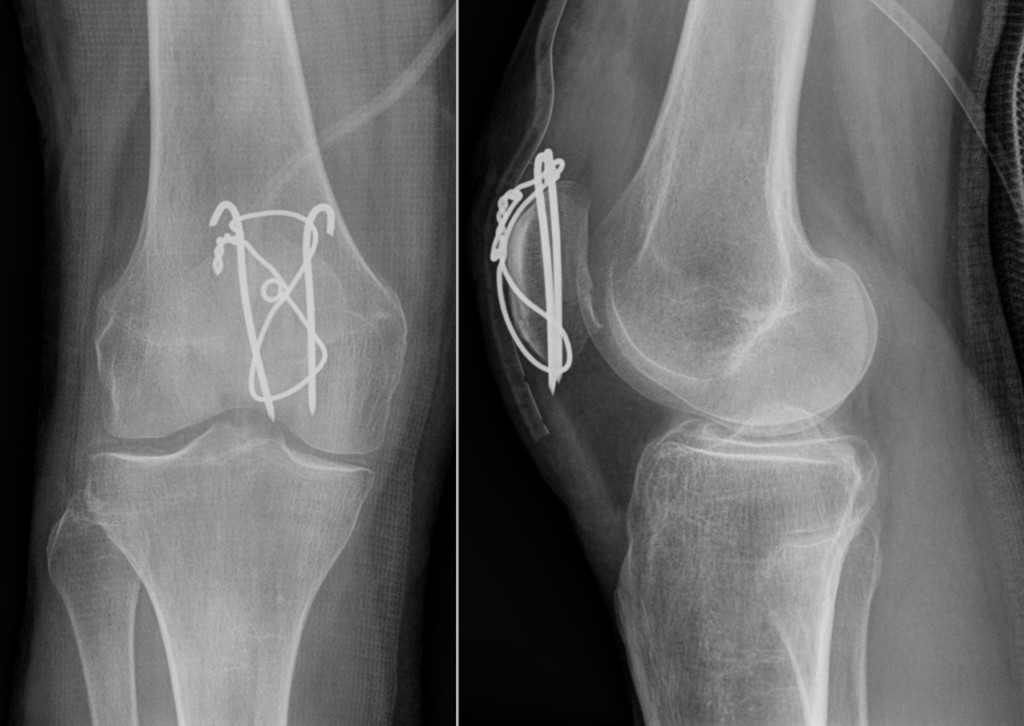
- Transverse patellar fractures
- Avulsion fractures of the medial malleolus and greater tuberosity can use the same principle
- Comminuted olecranon fractures need plating
Position
- Olecranon, lateral decubitus or prone with the arm over a bolster
- Patella, supine with a thigh tourniquet
- Image intensifier available
- Tourniquet for the arm when lateral
Operative Steps
- Reduce the fracture and hold with a pointed reduction clamp
- Two parallel K wires across the fracture
- Olecranon wires can engage the anterior ulnar cortex, avoiding overpenetration into the forearm
- Figure of eight wire passed deep to the K wire ends and tensioned on both sides
- Bend and bury K wire ends
- Converts tensile force into compression at the articular surface during flexion
- Pass the wire deep to the triceps insertion close to bone
- Use a drill hole in the ulna 3 to 4 cm distal to the fracture for the distal limb of the wire
- Twist both sides of the figure of eight evenly to balance compression
Postoperative Care
- Early active motion
- Patella, protect extension until healing
- Radiographs at 2 and 6 weeks
- Avoid resisted extension until union
Complications
- Symptomatic hardware is common and often needs removal
- Wire migration
- Not suitable for comminuted or oblique fractures
- Loss of fixation and nonunion
- Infection over subcutaneous hardware
- Ulnar nerve irritation
Related Pages
Reviewed by Professor Phong Tran, Head of Orthopaedic Surgery, Western Health. Last updated 10 October 2026.