
Epidemiology
- About 1% of all fractures
- Direct blow or eccentric quadriceps contraction against a flexed knee
Classification
Descriptive
| Type | Description |
|---|---|
| Transverse | Most common, often from indirect quadriceps loading |
| Upper or lower pole | Extra-articular avulsions of quadriceps or patellar tendon |
| Vertical or marginal | Direct load in flexion, extensor mechanism usually intact |
| Stellate or comminuted | Direct blow, often with cartilage damage |
| Osteochondral | After patellar dislocation, medial facet or lateral femoral condyle |
| Sleeve fracture | In children, cartilage avulsed from the lower pole with a small bony fragment |
- Displacement means an articular step over 2 mm or a gap over 3 mm
AO/OTA 34
| Type | Description |
|---|---|
| 34A | Extra-articular, including pole avulsions and body fractures sparing the articular surface |
| 34B | Partial articular vertical fractures of the medial or lateral facet |
| 34C | Complete articular, from simple transverse (C1) through extra fragment (C2) to comminuted (C3) |
Original publication Meinberg EG, Agel J, Roberts CS, Karam MD, Kellam JF. Fracture and Dislocation Classification Compendium-2018. J Orthop Trauma. 2018;32 Suppl 1:S1-S170.
Investigations
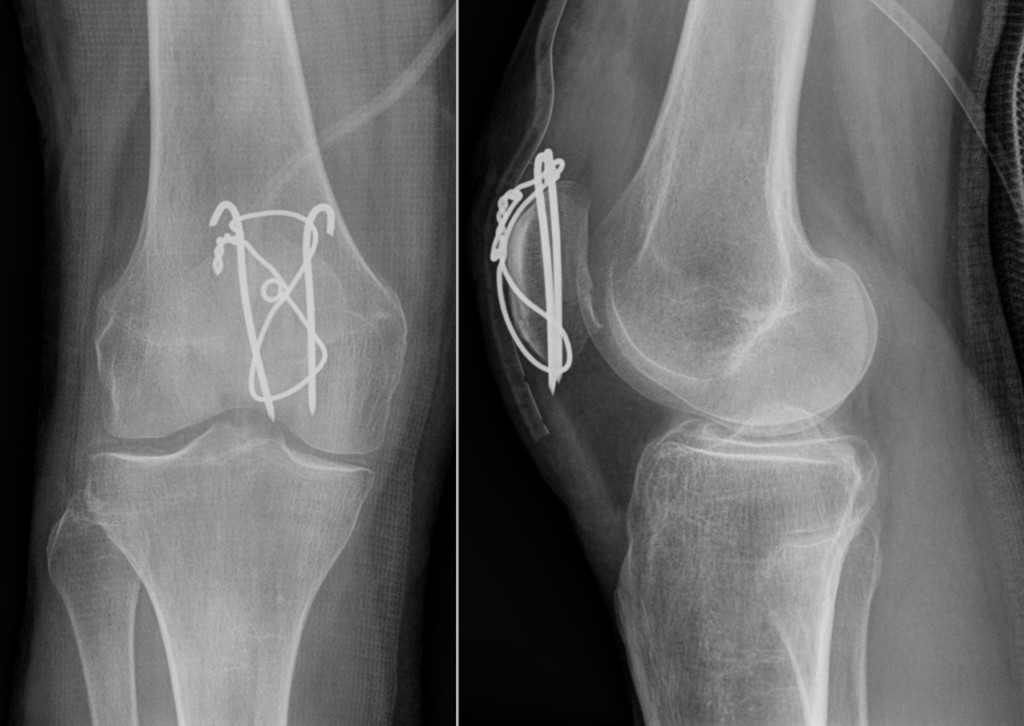
- AP, lateral and skyline views
- Skyline detects vertical and marginal fractures missed on AP and lateral
- CT defines comminution and articular involvement before fixation
- Bipartite patella is superolateral, bilateral, with smooth sclerotic margins, and should not be called a fracture
Management
- Straight leg raise against gravity tests extensor mechanism integrity
- Undisplaced with intact mechanism, hinged brace or cylinder cast in extension with early weight bearing
- Displaced transverse, tension band wiring, often over cannulated screws
- Displaced vertical, interfragmentary lag screws
- Comminuted, plate fixation, cerclage or both
- Unfixable comminuted pole, partial patellectomy with tendon reattached near the articular surface
- Osteochondral fragments fixed if large, excised if small, with stabilisation where indicated
- Total patellectomy reserved for unreconstructable injuries
Complications
- Symptomatic hardware is the commonest reason for further surgery
- Post-traumatic patellofemoral arthritis is common after articular injury
Reviewed by Professor Phong Tran, Head of Orthopaedic Surgery, Western Health. Last updated 10 October 2026.