
Definition
- Union is restoration of bony continuity with clinical stability and no pain
- Delayed union is failure to unite within the expected time, may still unite spontaneously
- Nonunion is arrest of healing with no further progress without intervention
- Gap filled with fibrous or cartilaginous tissue
- Commonly declared at 6 to 9 months, individualised for each fracture
- FDA definition is 9 months with no progress over 3 consecutive months
Pathology
- Primary healing occurs with absolute stability by cutting cones
- Secondary healing occurs with relative stability through callus
- Callus stages are inflammation, soft callus, hard callus and remodelling
- Perren strain theory allows bone formation below 2% strain
- Strain between 2 and 10% supports callus, above 10% gives fibrous tissue
Aetiology
- Mechanical causes include excess motion, gap and poor fixation
- Biological causes include soft tissue stripping, open fracture and poor blood supply
- Patient factors include smoking, diabetes, NSAIDs, steroids and vitamin D deficiency
- Infection must be excluded in every nonunion
Classification
Weber and Cech
| Type | Description |
|---|---|
| Hypertrophic | A mechanical problem with good biology |
| Oligotrophic | Little callus but viable ends |
| Atrophic | A biological problem with avascular ends |
| Infected | Infected nonunion |
| Pseudarthrosis | Synovial lined cavity |
Investigations
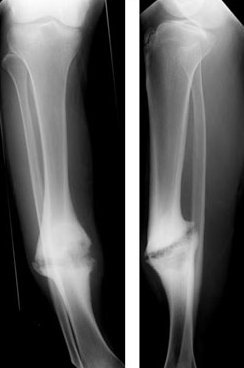
- Serial radiographs and CT to assess bridging
- RUST score for tibial fractures
- FBC, CRP, ESR and deep cultures for infection
- Vitamin D, calcium, thyroid and glucose studies
Management
- Diamond concept (Giannoudis) addresses cells, scaffold, growth factors and mechanical stability
- Hypertrophic needs more stability, such as compression plating or exchange nailing
- Atrophic needs biology, such as debridement and autograft
- Infected nonunion needs debridement, culture specific antibiotics and staged reconstruction
- Masquelet induced membrane or bone transport for large defects
- Address smoking and metabolic factors
Reviewed by Professor Phong Tran, Head of Orthopaedic Surgery, Western Health. Last updated 10 October 2026.