
Indications
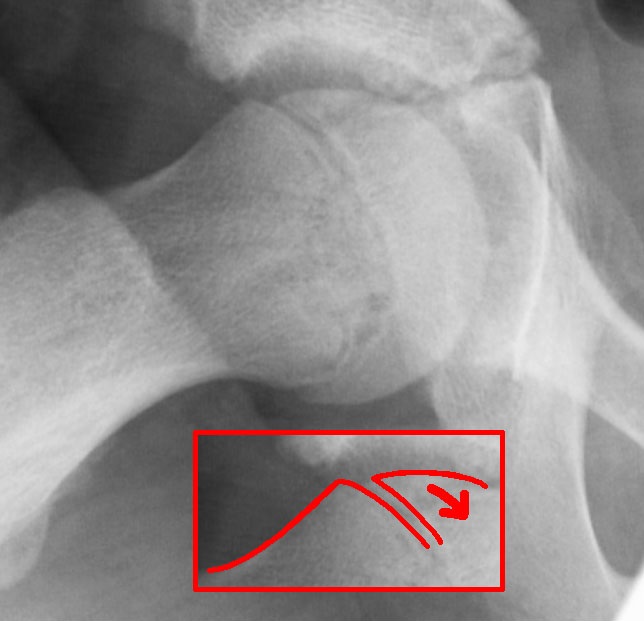
- Stable SUFE, able to bear weight (Loder)
- Unstable SUFE as an urgent procedure
- Prophylactic contralateral fixation with endocrine disease, age under 10 or high risk
- Severe deformity may later need a corrective osteotomy or surgical dislocation
Position
- Supine on a radiolucent or fracture table, no forced reduction
- Image intensifier for AP and true lateral views
Operative Steps
- Do not manipulate a stable slip
- Start point on the anterior femoral neck for a posterior slip
- Single cannulated screw perpendicular to the physis into the centre of the epiphysis
- At least four threads across the physis
- Screw tip short of the subchondral bone
- Rotate the leg under live fluoroscopy to exclude joint penetration
- Unstable slips, gentle positional reduction and capsular decompression are considered
- Use a partially threaded 6.5 or 7.3 mm screw
Postoperative Care
- Protected weight bearing, longer for unstable slips
- Follow both hips to skeletal maturity
- Radiographs at 6 weeks and every few months until physeal closure
- Avoid contact sport until the physis begins to close
- Investigate endocrine disease in atypical patients
Complications
- Avascular necrosis, mostly with unstable slips
- Chondrolysis from joint penetration
- Slip progression
- Femoroacetabular impingement
- Chondrolysis from unrecognised screw penetration
- Slip progression
- Femoroacetabular impingement
Related Pages
Reviewed by Professor Phong Tran, Head of Orthopaedic Surgery, Western Health. Last updated 10 October 2026.