
Indications
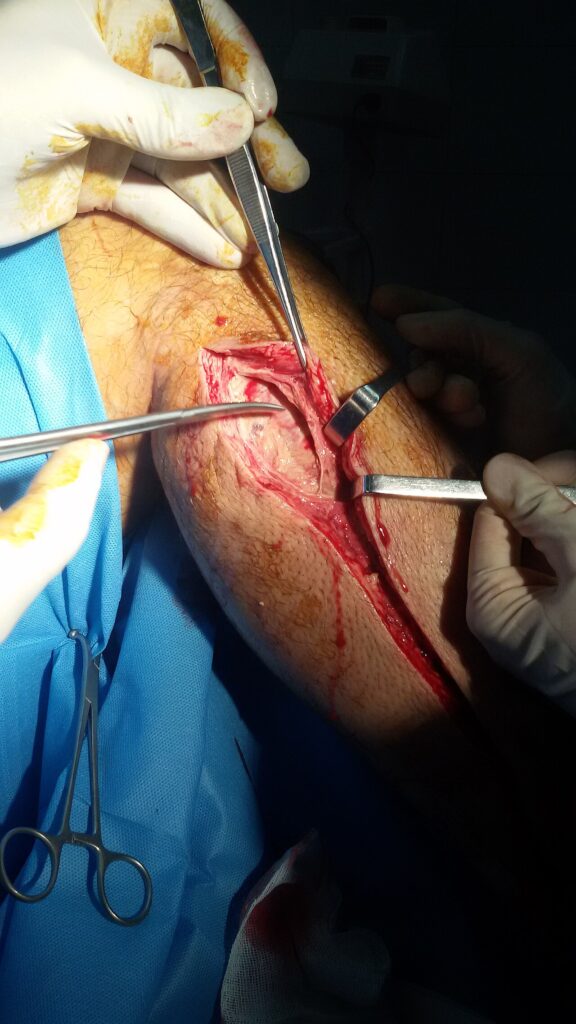
- Clinical compartment syndrome
- Delta pressure (diastolic minus compartment pressure) under 30 mmHg
- Prophylactic after revascularisation with long ischaemia time
- Prophylactic fasciotomy after revascularisation of prolonged ischaemia
Position
- Supine, no tourniquet inflation
- Tourniquet available but not inflated
Operative Steps
- Two incisions, each about 15 to 20 cm
- Anterolateral incision 2 cm anterior to the fibula. Identify the intermuscular septum and release anterior and lateral compartments
- Protect the superficial peroneal nerve as it pierces the fascia in the distal third
- Posteromedial incision 2 cm posterior to the medial tibial border. Protect the saphenous vein and nerve
- Release the superficial posterior compartment, then detach soleus from the tibia to open the deep posterior compartment
- Check all muscle and debride dead tissue. Leave wounds open
- Measure compartment pressures if the diagnosis is uncertain
Postoperative Care
- Return to theatre at 48 to 72 hours for debridement
- Delayed primary closure, shoelace technique or split skin graft
- Stabilise any fracture at the first operation
- Delayed primary closure or skin grafting at 48 to 72 hours
Complications
- Missed deep posterior compartment
- Superficial peroneal and saphenous nerve injury
- Infection, chronic venous insufficiency, ugly scars
- Delayed fasciotomy increases infection and amputation
Related Pages
Reviewed by Professor Phong Tran, Head of Orthopaedic Surgery, Western Health. Last updated 10 October 2026.