
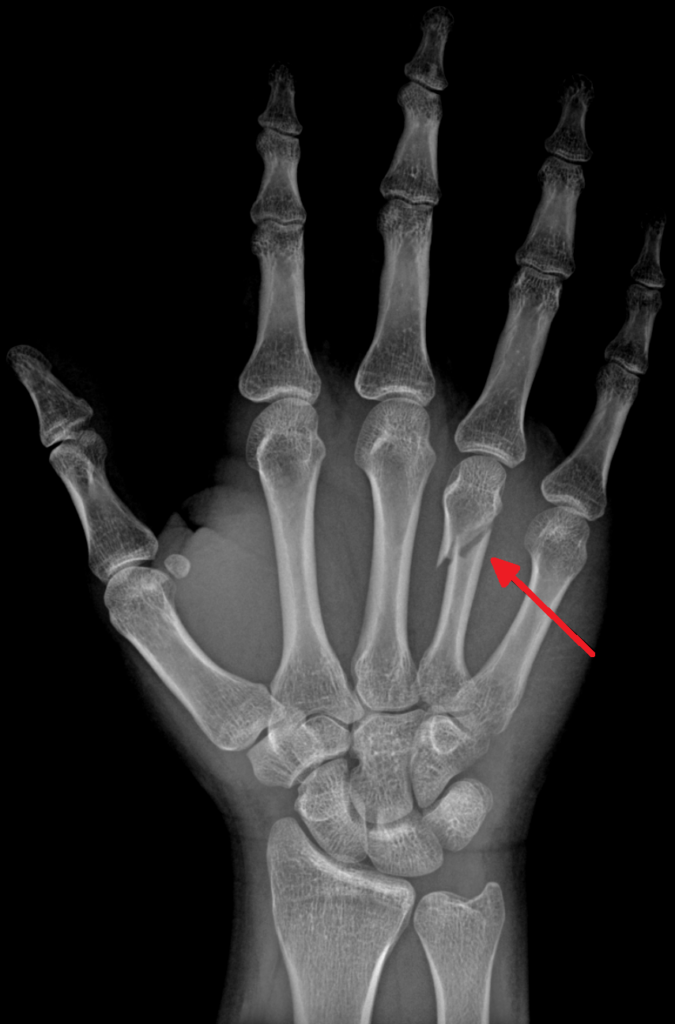
Indications
- Rotational malalignment, seen as scissoring on flexion
- Unstable or shortened fractures
- Intra-articular step
- Multiple or open fractures
- Most metacarpal and phalangeal fractures are treated without surgery
- Boxer fractures of the fifth metacarpal neck tolerate up to about 70 degrees of angulation
- Rotational deformity of even 5 degrees can cause scissoring
Position
- Supine, hand table, tourniquet
- Image intensifier with a mini C arm
- WALANT allows assessment of active tendon gliding
Operative Steps
- Check rotation with tenodesis or active flexion under WALANT
- K wires, crossed or intramedullary, for closed reduction
- Lag screws for long oblique or spiral fractures at least twice the bone diameter
- Dorsal plates for unstable shaft fractures, at the cost of tendon adhesion
- Intramedullary headless screws for transverse metacarpal fractures
- Bennett fractures need reduction of the metacarpal shaft against the volar beak
- Condylar fractures of the phalanx are unstable and need fixation
- Avoid placing plates on the dorsum of proximal phalanges where possible
Postoperative Care
- Early motion in a hand therapy program
- Buddy strapping
- Position of safe immobilisation with MCP joints flexed and IP joints extended
- K wires removed at about 4 weeks
Complications
- Stiffness and extensor tendon adhesions
- Malrotation
- Pin tract infection
- Nonunion is rare
- Loss of reduction with early motion after wire fixation
Related Pages
Reviewed by Professor Phong Tran, Head of Orthopaedic Surgery, Western Health. Last updated 10 October 2026.