
Indications
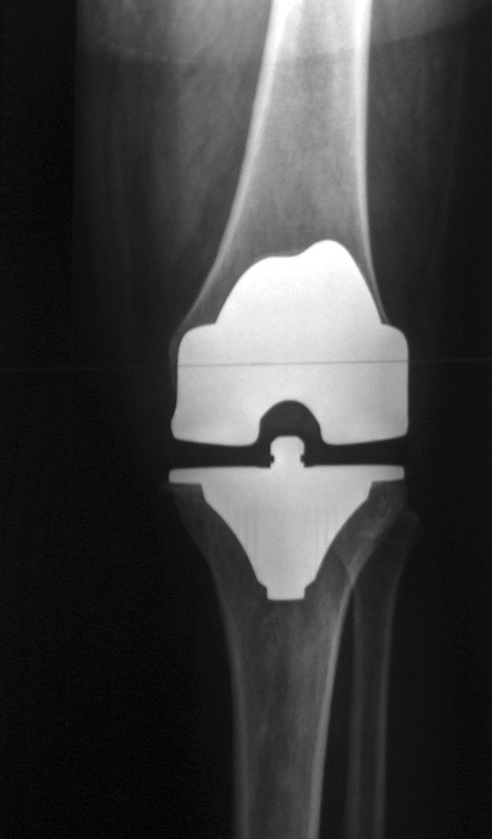
- End stage knee arthritis failing non-operative care
- Inflammatory arthritis and post-traumatic arthritis
- Unicompartmental arthroplasty or osteotomy for isolated disease in selected patients
- Contraindicated with active infection
- Age, weight and expectations are discussed before surgery
Position
- Supine, side and foot supports to hold flexion, thigh tourniquet
- Tourniquet use is optional
Operative Steps
- Medial parapatellar arthrotomy
- Distal femoral cut perpendicular to the mechanical axis, about 5 to 7 degrees valgus to the anatomical axis
- Proximal tibial cut perpendicular to the mechanical axis with the slope of the implant
- Femoral rotation parallel to the transepicondylar axis, about 3 degrees external to the posterior condyles
- Balance flexion and extension gaps by measured resection or gap balancing
- Varus knee releases are medial. Valgus knee releases are lateral
- Resurface the patella if planned and check tracking
- Cemented fixation is most common in Australia (AOANJRR)
- Remove posterior osteophytes to improve extension
- Wash and dry bone surfaces before cementing
Postoperative Care
- Early motion and weight bearing as tolerated
- VTE prophylaxis
- Multimodal analgesia and early mobilisation
- Physiotherapy to achieve 90 degrees flexion early and full extension
Complications
- Infection
- Stiffness
- Instability
- Periprosthetic fracture
- Common peroneal nerve palsy after correcting a valgus flexion deformity
- Patellofemoral problems
- Aseptic loosening
- Periprosthetic fracture
Related Pages
Reviewed by Professor Phong Tran, Head of Orthopaedic Surgery, Western Health. Last updated 10 October 2026.