
Indications
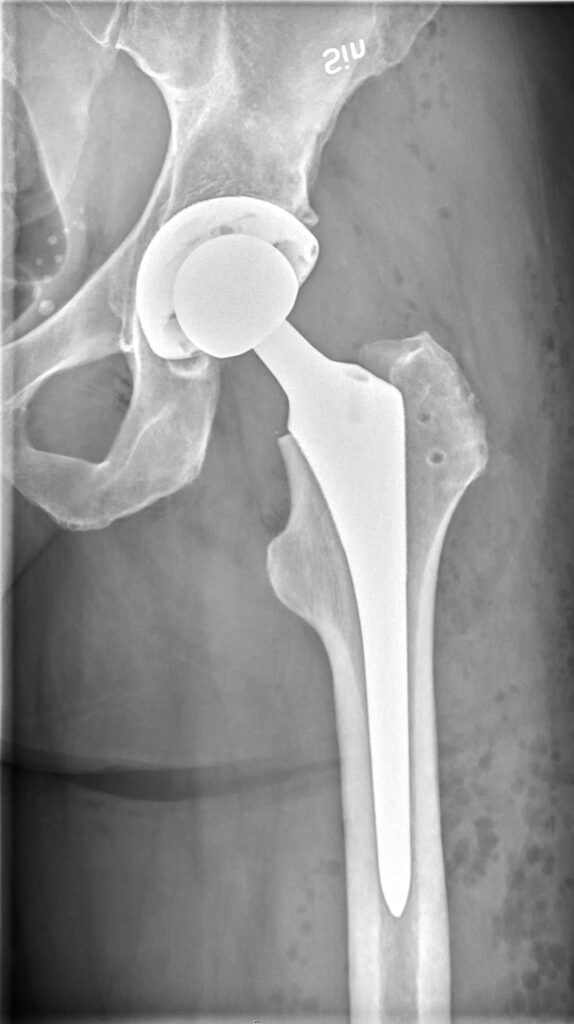
- End stage hip arthritis failing non-operative care
- Displaced femoral neck fractures in active independent patients
- Avascular necrosis with collapse
- Displaced femoral neck fractures in active, independent patients
Position
- Lateral decubitus for posterior and lateral approaches
- Supine for the direct anterior approach
- Lateral decubitus for posterior and lateral approaches, supine for the direct anterior approach
Operative Steps
- Template for cup size, stem size, offset and leg length
- Posterior approach splitting gluteus maximus, releasing piriformis, short external rotators and capsule as a layer for repair
- Neck cut at the templated level
- Ream the acetabulum to the true floor
- Cup at about 40 degrees inclination and 15 to 20 degrees anteversion (Lewinnek safe zone)
- Broach the femur and trial
- Check leg length, offset, combined anteversion and stability in flexion with internal rotation
- Implant definitive components and repair capsule and rotators
- Template preoperatively for size, offset and leg length
Postoperative Care
- Weight bear as tolerated
- VTE prophylaxis
- Hip precautions after a posterior approach
- Dislocation precautions depend on approach and surgeon preference
- Most patients walk with an aid on day 1
Complications
- Dislocation
- Leg length difference
- Periprosthetic fracture
- Infection
- Sciatic nerve palsy
- Aseptic loosening and wear
- Leg length discrepancy
- Aseptic loosening and wear in the long term
Related Pages
Reviewed by Professor Phong Tran, Head of Orthopaedic Surgery, Western Health. Last updated 10 October 2026.