
Definition
- Painful prominence over the lateral fifth metatarsal head
- Named after tailors sitting cross-legged
Aetiology
- Narrow toe box footwear
- Splay foot and forefoot widening
- Associated hallux valgus
- Familial tendency
- Often bilateral in adolescents
Classification
Coughlin
| Type | Description |
|---|---|
| 1 | Enlarged fifth metatarsal head or lateral condyle |
| 2 | Lateral bowing of the fifth metatarsal shaft with a normal intermetatarsal angle |
| 3 | Increased fourth to fifth intermetatarsal angle, the most common |
Original publication Coughlin MJ. Treatment of bunionette deformity with longitudinal diaphyseal osteotomy with distal soft tissue repair. Foot Ankle. 1991;11(4):195-203.
Clinical Features
- Pain and swelling over the lateral fifth metatarsal head, worse in shoes
- Callus or bursitis over the prominence
- Plantar callus with a plantar prominence
- Fifth toe varus
Investigations
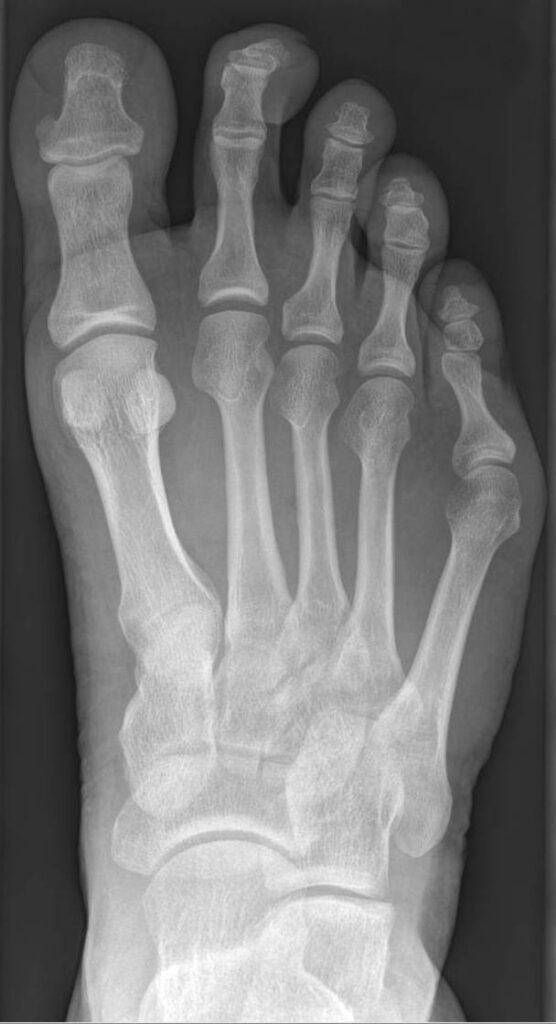
- Weight bearing AP, lateral and oblique radiographs
- Assess head size, lateral bowing, fourth to fifth intermetatarsal angle and fifth MTP angle
- Normal fourth to fifth intermetatarsal angle is under about 8°
Management
- Wide toe box shoes, padding, shoe stretching and callus care first
- Surgery for symptoms resistant to non-operative care
- Lateral condylectomy for type 1 with a normal intermetatarsal angle
- Distal (chevron) osteotomy for mild to moderate deformity and type 2 bowing
- Diaphyseal or proximal (oblique or scarf) osteotomy for intermetatarsal angle above 8°, often type 3
- Defer surgery in adolescents until skeletal maturity, as recurrence is more likely with growth remaining
Complications
- Recurrence
- Over-resection causing instability or medial subluxation of the fifth toe
- Delayed union or non-union
- Transfer metatarsalgia
- Sural or dorsolateral cutaneous nerve injury
Reviewed by Professor Phong Tran, Head of Orthopaedic Surgery, Western Health. Last updated 10 October 2026.