
Epidemiology
- Talus is second most common site for OCD
- Commonly occurs anterolaterally or posteromedially
- 50% children present after trauma. Mean age of presentation is 13-14 years
Classification
| Grading | Description |
|---|---|
| I | undisplaced |
| II | partially detached |
| III | detached but not displaced |
| IV | detached + displaced or rotated |
History
- pain
- swelling
- instability
- repetitive sprains
Examination
- ↓ ROM
- painful ROM
- Local tenderness
Investigations
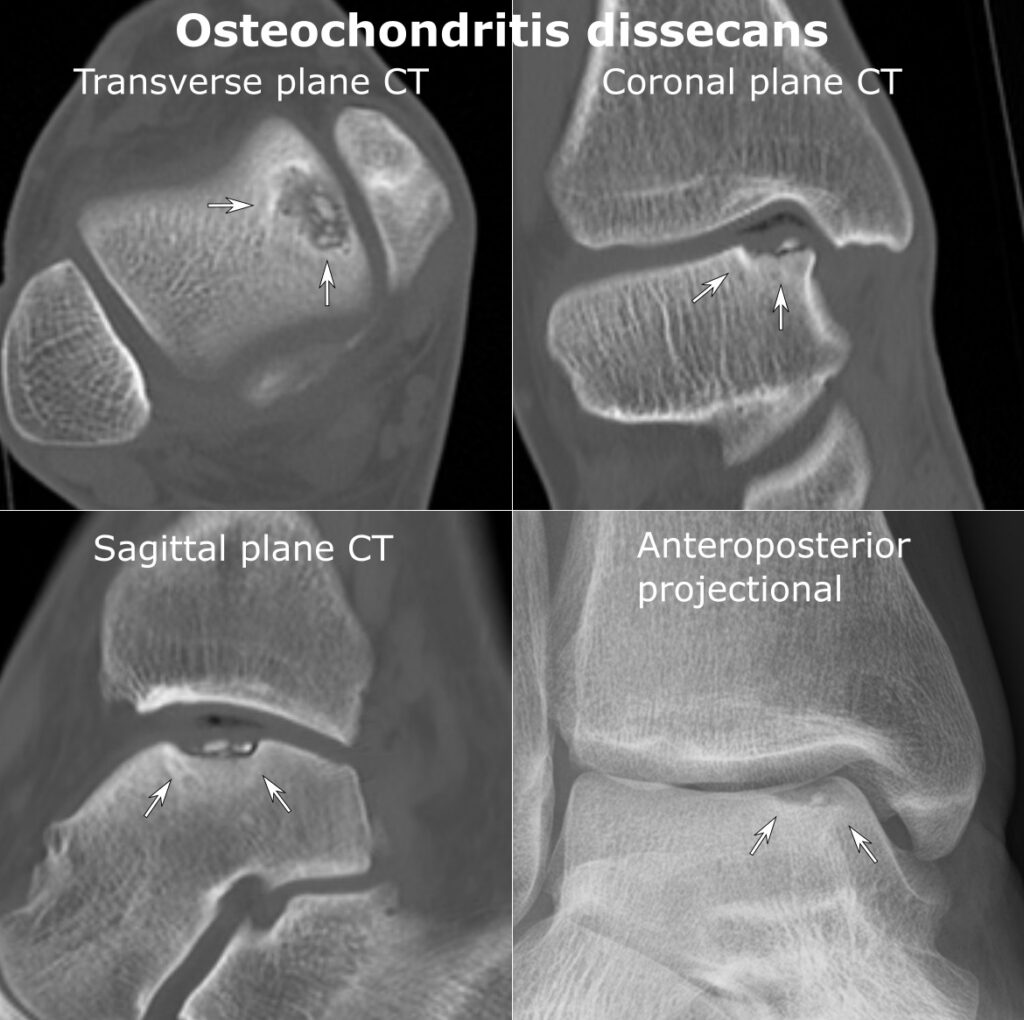
- X-ray
- OCD can be difficult to identify on X-ray
- MRI
- can define extent of lesion
- extent of sclerosis displacement
- whether articular cartilage is intact (fluid beneath OCD fragment denotes articular cartilage breach)
Treatment
- Course of OCD talus is more benign in children than in adults
- Initial treatment for types 1-3 is nonoperative with cast immobilisation + protected weightbearing
- Type 4 lesions (or failed nonoperative treatment for types 1-3) require drilling, debridement & fixation
Reviewed by Professor Phong Tran, Head of Orthopaedic Surgery, Western Health. Last updated 10 October 2026.