
Indications
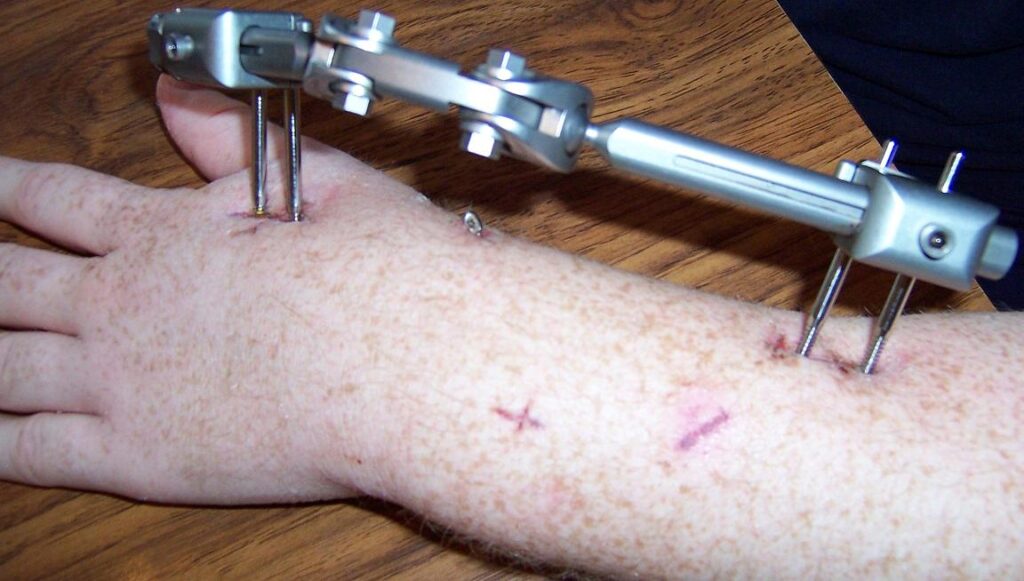
- Damage control for unstable high energy periarticular fractures of the knee, ankle and pilon
- Soft tissue swelling or blistering that prevents early fixation
- Polytrauma physiology
- Damage control in the polytrauma patient
Position
- Supine on a radiolucent table with a bump under the limb
- Radiolucent table, image intensifier
Operative Steps
- Restore length and alignment with traction under fluoroscopy
- Place pins outside the zone of injury and away from future incisions
- Knee spanning frame uses two femoral pins anterolaterally and two tibial pins anteromedially
- Ankle spanning frame uses two tibial pins and a transcalcaneal pin, with or without a first metatarsal pin
- Connect clamps and bars, bar close to the skin for stiffness
- Check reduction and pin positions on fluoroscopy
- Avoid placing pins in the zone of future definitive fixation
- Two pins in each main segment, placed through safe corridors
- Check length, alignment and rotation before tightening
Postoperative Care
- Elevate and wait for soft tissues, usually 7 to 14 days
- CT with the frame on to plan definitive fixation
- Daily pin site care
- Elevation and swelling control
Complications
- Pin site infection
- Loss of reduction
- Neurovascular injury during pin insertion
- Pin site infection
Related Pages
Reviewed by Professor Phong Tran, Head of Orthopaedic Surgery, Western Health. Last updated 10 October 2026.