
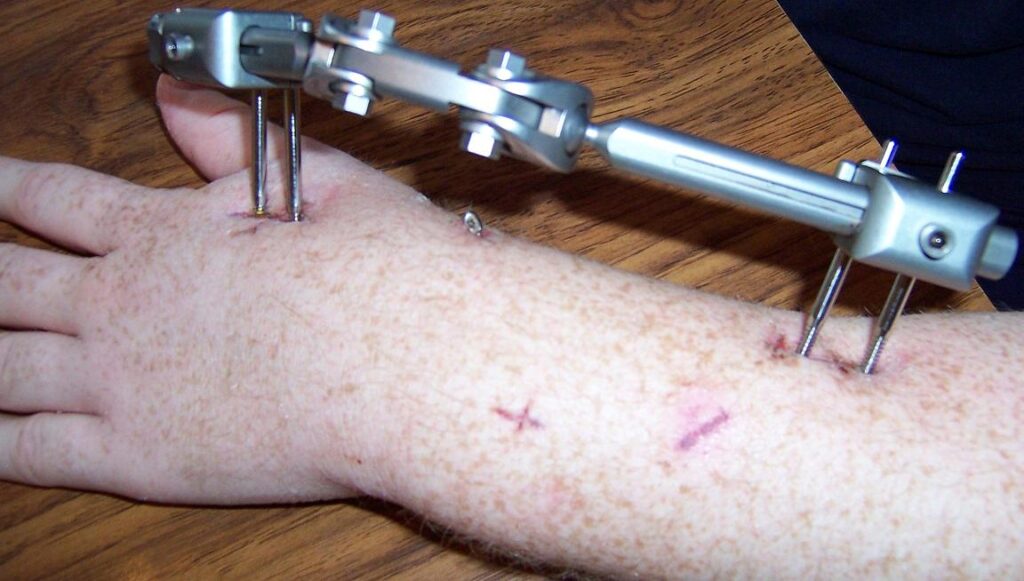
Principles
- Low complication rate
- Not obtrusive
- Stiff enough to maintain alignment
- Facilitate weight bearing
- Adaptable
Classification
| Type | Description |
|---|---|
| Simple | Pin-rod |
| Clamp | Differs from simple frame only in pin-rod connection (eg Hoffman) |
| Ring | |
| Hybrid |
Frame Configurations
- Uniplanar – unilateral (encompass extremity sector < 90o)
- bilateral (encompass extremity sector > 90o)
- Biplanar – unilateral & bilateral
Methods of Increasing Stiffness in Ex Fix
- Axial or bending compression may be beneficial: encourages periosteal healing
- Shear or torsional motion may be detrimental
- Fracture end contact (most important)
- Increase pin diameter
- Widely separate pins in fragment
- Placement of pins near fracture site
- Radial pretensioning of pin*
- Decrease bone to rod distance
- Increase number of support rods
- Increase number of planes
- predrill using drill bit slightly smaller than diameter of pin shank (0.2mm smaller than shank)
- Longitudinal pretensioning is now NOT recommended (necrosis of compressed near cortex)
Indications
- Open fractures
- Fractures with severe soft tissue damage
- Including burns, vessel/ nerve injury
- Infected fractures
- Nonunions
- Fracture stabilisation in multitrauma prior to transfer
- Limb length discrepancy or malalignment
- Certain paediatric fractures (to avoid growth plate)
- Arthrodesis
Fracture Healing with Ex Fix
- Primary & secondary bone healing depending on rigidity of construct
- Predominantly secondary bone healing
- Haematoma
- Inflammation
- Neoangiogenesis
- Soft Callus
- Hard Callus
- Remodelling
- Gap healing only if excellent apposition with rigid fixation (eg. High tibial osteotomy site)
Dynamisation
- Two concepts
- Late dynamisation once rotational stability afforded by callus
- Early dynamisation to promote callus formation then make rigid at 6 weeks to allow regenerate bone to mature
- Passive – load transmission through fracture site due to pin bending with wt bearing
- Active axial – load transmission through fracture site with wt bearing using telescopic side rod
- Controlled axial – using telescopic side bar to vary amount of axial compression
Safe Zones
- Avoid neurovascular structures
- Do not transfix muscle or tendon
- Do not enter synovial lining of joint
Prevention of Pin Loosening
- Predrill with radial pretensioning
- Cool with water
- Insertion of pin by hand
Pin-site Care
- Most important is preventative measures on insertion of pins/ wires
- There is NO consensus on pin site management
- Good general protocol is
- Longitudinal incisions
- Detension skin around pin
- Chlorhexidine-soaked sponge around pins/ wires
- Leave intact for 4 days
- Daily saline baths with cotton bud
- Remove crusts & avoid oily compounds so not occlude outflow
- Loose gauze dressing can be used to prevent contamination
- Can allow to get wet after 1-2 weeks
- (Some advocate no dressings at all using daily saline baths only)
Complications
- Overdistraction
- Neurovascular injury
- Pin track infection (8% per pin for duration of frame)
- Joint entered with septic arthritis
- Joint contractures
- Reduced load transmission
Internal Fixation Following Ex Fix
- < 72 hrs: can nail straight away
- > 72 hrs: ex fix for 10 days
- : splint/ traction 10 days
- : nail at 3 weeks
- Studies by Gustilo show that nailing can be done up to 3 weeks following ex fix application
- Earlier is better
- If ex fix for 3 weeks or longer: then cast for same period of time
- ? UTN at that time
- Reported rates of infection of IM nail following ex fix 5-50%
Reviewed by Professor Phong Tran, Head of Orthopaedic Surgery, Western Health. Last updated 10 October 2026.