
Indications
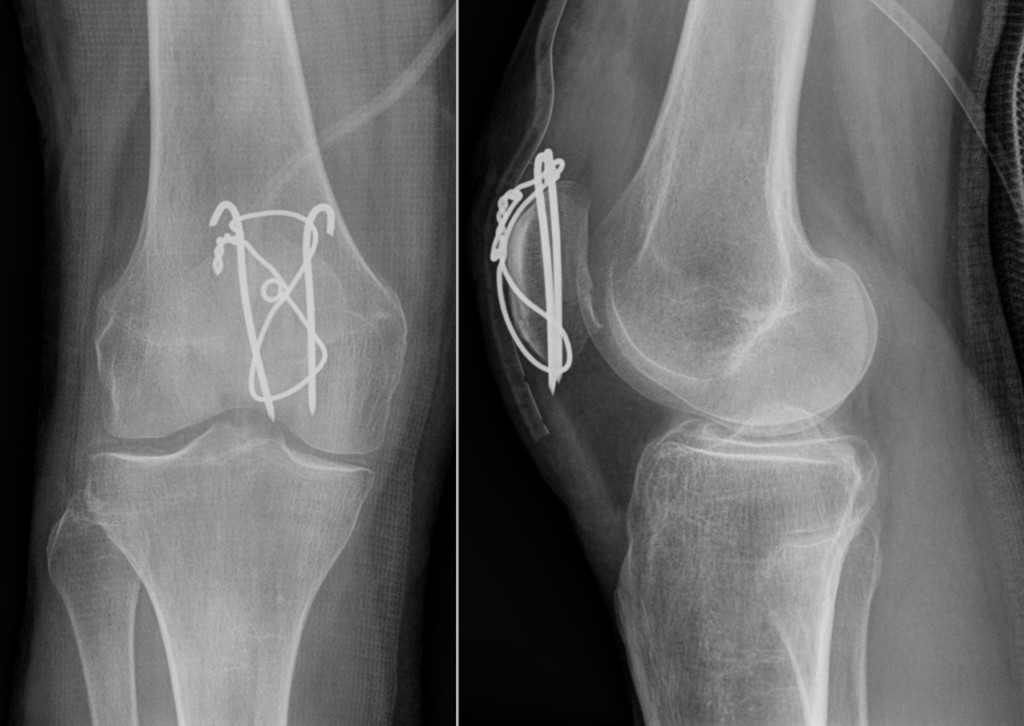
- Patellar fracture with extensor lag, step over 2 mm or gap over 3 mm
- Complete quadriceps or patellar tendon rupture
- Undisplaced fractures with an intact straight leg raise are treated in a brace
- Open fractures need urgent debridement
Position
- Supine, thigh tourniquet
- Image intensifier for fracture fixation
- Bump under the ipsilateral hip to correct external rotation
Operative Steps
- Longitudinal midline incision
- Transverse patellar fractures, tension band wiring or cannulated screws with a tension band
- Comminuted lower pole, partial patellectomy with transosseous reattachment of the patellar tendon
- Quadriceps tendon rupture, locking sutures through vertical patellar tunnels or anchors
- Patellar tendon rupture, transosseous repair protected by a cerclage wire or suture
- Repair the retinacula
- Check patellar height against the other side
- Clear haematoma and inspect the articular surface through the retinacular tear
- Reduce with pointed reduction clamps and check the joint surface by palpation and imaging
- Suture fixation reduces hardware irritation
Postoperative Care
- Hinged brace locked in extension, then progressive flexion
- Early quadriceps activation
- Flexion limits increase by about 30 degrees every 2 weeks
- Avoid resisted extension for 12 weeks after tendon repair
Complications
- Extensor lag and weakness
- Stiffness and patella baja
- Symptomatic hardware
- Re-rupture
- Hardware irritation is common and often leads to removal
- Patellofemoral arthritis after articular fractures
- Infection and wound breakdown
Related Pages
Reviewed by Professor Phong Tran, Head of Orthopaedic Surgery, Western Health. Last updated 10 October 2026.