
Definition
- Fracture through bone weakened by disease, usually from low energy trauma
- Impending fracture is a lesion at high risk of failure under physiological load
Aetiology
- Metastatic carcinoma, commonest in adults, from breast, prostate, lung, kidney and thyroid
- Myeloma and lymphoma
- Primary bone sarcomas
- Benign lesions such as bone cyst, NOF, fibrous dysplasia, enchondroma and GCTB
- Osteoporosis, osteomalacia, hyperparathyroidism and Paget disease
- Infection, irradiated bone and antiresorptive related atypical femoral fractures
Investigations
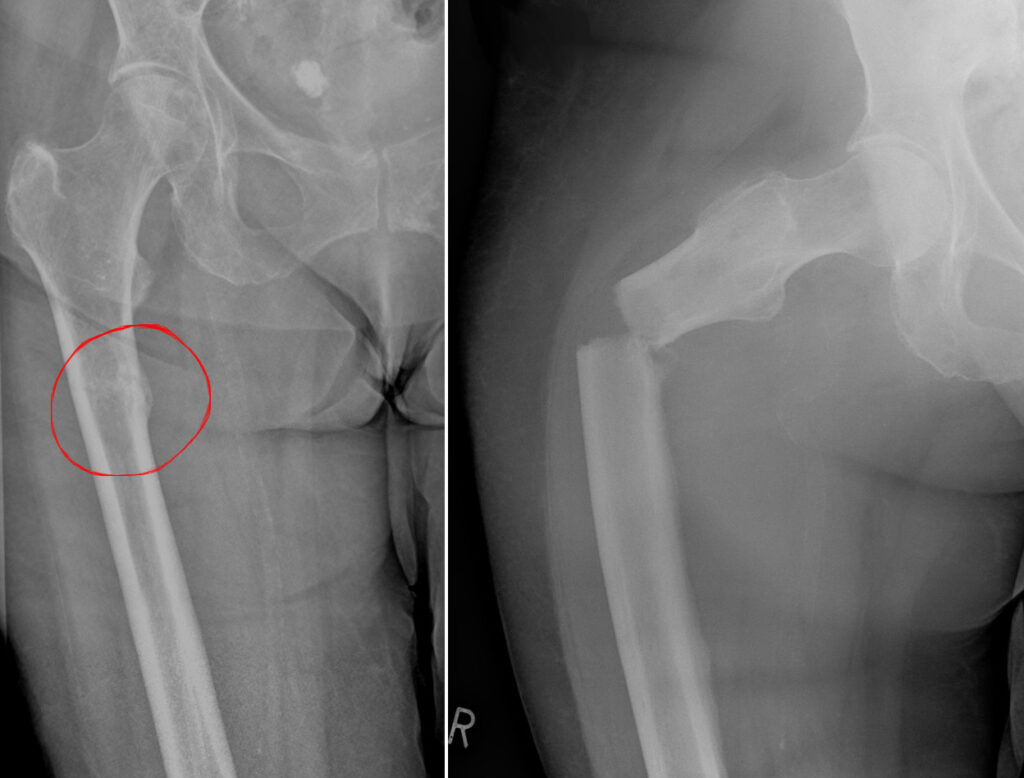
- Never assume a solitary destructive lesion is a metastasis
- Fixing an undiagnosed sarcoma contaminates the bone and may force amputation
- Examine breast, thyroid, prostate and lymph nodes
- Calcium, electrophoresis with serum free light chains and PSA where relevant
- Radiograph the whole bone with joints above and below
- CT chest, abdomen and pelvis plus bone scan or PET
- Biopsy if no known primary, a solitary lesion or long disease free interval
- Correct hypercalcaemia before surgery
Classification
Four variables score 1 to 3, total 4 to 12
| Variable | 1 | 2 | 3 |
|---|---|---|---|
| Site | Upper limb | Lower limb | Peritrochanteric |
| Pain | Mild | Moderate | Functional |
| Lesion | Blastic | Mixed | Lytic |
| Size | Under one third | One third to two thirds | Over two thirds |
Original publication Mirels H. Metastatic disease in long bones. A proposed scoring system for diagnosing impending pathologic fractures. Clin Orthop Relat Res. 1989(249):256-64.
- Score 9 or more supports prophylactic fixation
- Score 8 is borderline, 7 or less treated with radiotherapy and observation
- Functional pain is a strong predictor alone
Management
- Prophylactic fixation gives less blood loss, shorter stay and better function
- Protect the whole bone, usually with a long intramedullary nail
- Assume non-union, especially in lung cancer and myeloma
- Cemented arthroplasty or endoprosthesis for femoral head and neck lesions
- Cement augmentation after curettage of lytic lesions
- Preoperative embolisation for renal cell and thyroid metastases
- Wide resection of solitary renal or thyroid metastases may improve survival
- PathFx or SPRING estimate survival to guide construct choice
- Postoperative radiotherapy to the whole field reduces progression, failure and reoperation
Reviewed by Professor Phong Tran, Head of Orthopaedic Surgery, Western Health. Last updated 10 October 2026.