
Indications
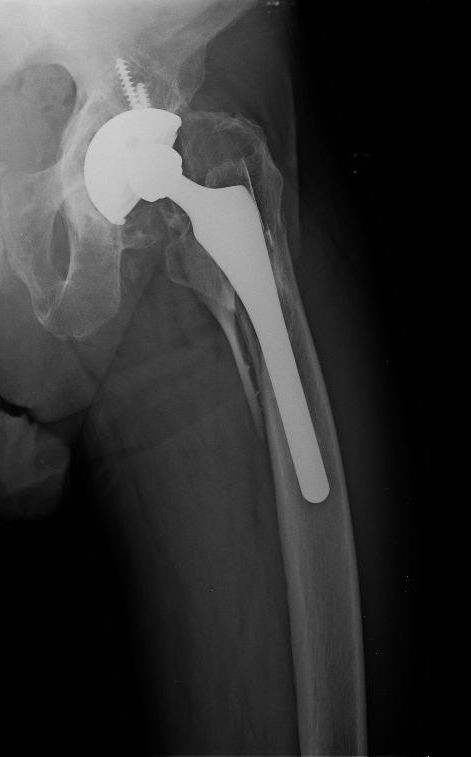
- Fractures around a hip replacement, managed by Vancouver type
- B1 stable stem, fixation
- B2 loose stem, revision
- B3 loose stem with poor bone, revision with augmentation or proximal femoral replacement
- Vancouver A fractures of the trochanters are often treated without surgery
- Vancouver C fractures well below the stem are fixed as a standard femoral fracture, protecting the stem with an overlapping plate
Position
- Lateral decubitus
- Image intensifier and long plates and revision stems available
- Prepare the leg free for traction and rotation
Operative Steps
- Assess stem stability on X-ray and directly at surgery
- B1, locking plate with cables and screws, spanning the whole femur and overlapping the stem
- B2, long distally fixed revision stem bypassing the fracture by two cortical diameters
- Cerclage the proximal fragments around the new stem
- Take tissue samples for culture
- Preoperative CRP and ESR, and aspirate if infection is suspected
- Lateral approach with an extended trochanteric osteotomy for revision when the stem is well fixed proximally
- Restore length and rotation before fixation
Postoperative Care
- Protected weight bearing
- Follow up for union and stem subsidence
- Weight bearing guided by fixation and bone quality
- Treat osteoporosis after the fracture
Complications
- Nonunion and fixation failure
- Dislocation after revision
- Infection
- Mortality is similar to that after hip fracture
- Periprosthetic fracture around the new implant
Related Pages
Reviewed by Professor Phong Tran, Head of Orthopaedic Surgery, Western Health. Last updated 10 October 2026.