
Question
A 9 year old boy fractures his proximal humerus after a minor fall. The radiograph shows a central lytic lesion in the metaphysis with a fallen leaf sign.
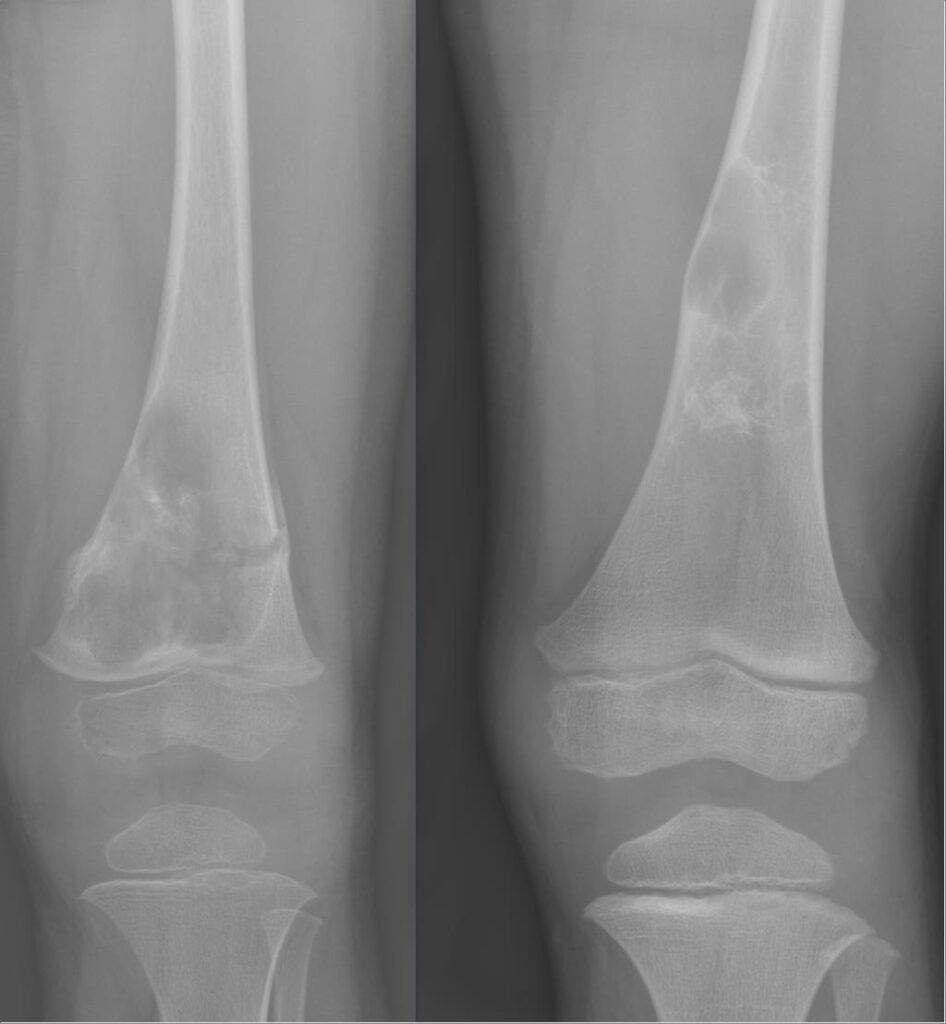
- What is the diagnosis and differential diagnosis?
- What is the natural history?
- What are the treatment options?
Answer
Diagnosis and differential
- Simple (unicameral) bone cyst with a pathological fracture
- Central, metaphyseal, fluid filled lesion in children aged 5 to 15, most often in the proximal humerus and femur
- Fallen leaf sign, a cortical fragment lying in the dependent part of the cyst
- Differential diagnoses are aneurysmal bone cyst (eccentric, expansile, fluid levels on MRI), fibrous dysplasia and enchondroma
Natural history
- Active cysts lie next to the physis and latent cysts migrate away with growth
- Fracture occurs in most and sometimes stimulates healing
- Many cysts heal by skeletal maturity
Treatment
- Allow the humeral fracture to heal in a sling, then review the cyst
- Aspiration and injection of steroid or bone marrow, often repeated
- Curettage and grafting or decompression with a cannulated screw or flexible nails
- Proximal femoral cysts are fixed because of the risk of fracture and avascular necrosis
- Recurrence is common, especially in active cysts and younger children
Related pages
Author Contributions
Orthofracs team
Reviewed by Professor Phong Tran, Head of Orthopaedic Surgery, Western Health. Last updated 10 October 2026.