
Question
A 58 year old man has 12 months of sacral pain and recent constipation. His pelvic radiograph and biopsy are shown.
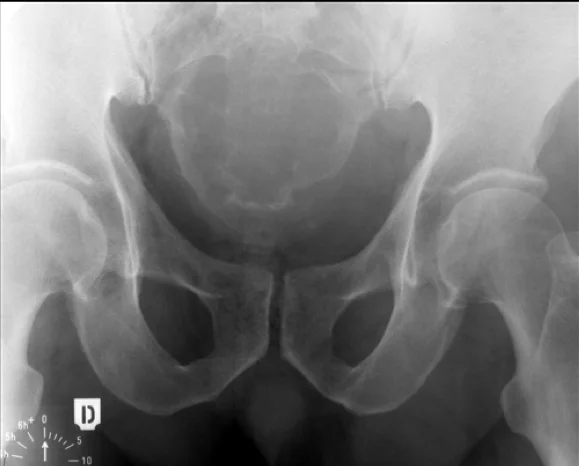
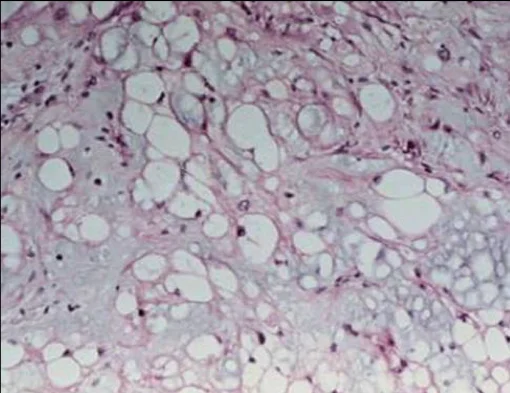
- What is the diagnosis?
- List three differential diagnoses.
- How would you manage him?
- What are the complications of treatment?
Answer
Diagnosis
- Sacral chordoma, a low to intermediate grade malignant tumour of notochordal remnants
- Lytic destruction of the sacrum with a large anterior soft tissue mass
- Histology shows physaliphorous cells with bubbly vacuolated cytoplasm in a myxoid stroma, positive for brachyury, S100 and keratin
- Sacrococcygeal region in about half, then skull base and mobile spine, peak age 50 to 60
Differential diagnosis
- Chondrosarcoma
- Giant cell tumour of the sacrum
- Metastasis or plasmacytoma
Management
- Refer to a sarcoma unit before biopsy, with the biopsy track placed posteriorly so it can be excised
- Stage with MRI of the pelvis and spine and CT of the chest
- En bloc resection with wide margins (sacrectomy) gives the best chance of local control
- Proton or carbon ion radiotherapy for unresectable tumours or as an adjunct
- Chordoma is resistant to conventional chemotherapy
Complications
- Bowel, bladder and sexual dysfunction depend on the sacral roots sacrificed, with function usually preserved if both S3 roots are kept
- Wound breakdown and infection, often needing flap reconstruction
- Pelvic instability after high sacrectomy
- Local recurrence, which is common after intralesional surgery, and late lung metastases
Related pages
Author Contributions
Orthofracs team
Reviewed by Professor Phong Tran, Head of Orthopaedic Surgery, Western Health. Last updated 10 October 2026.