
Definition
- Permanent irreducible lateral dislocation of the patella present at birth
- Patella lies lateral to a hypoplastic lateral femoral condyle
Aetiology
- Failure of internal rotation of the myotome containing quadriceps and patella in early development
- Associated with Down syndrome, nail patella syndrome and arthrogryposis
Pathology
- Tight contracted quadriceps and ITB
- Hypoplastic patella and flat trochlea
- Quadriceps acts as a knee flexor
Clinical Features
- Infant with knee flexion contracture, external tibial rotation and genu valgum
- Patella not palpable in the trochlea
- Patella cannot be reduced
- Lack of active knee extension and delayed walking
- Severity ranges from mild lateral position to fixed dislocation with severe contracture
Investigations
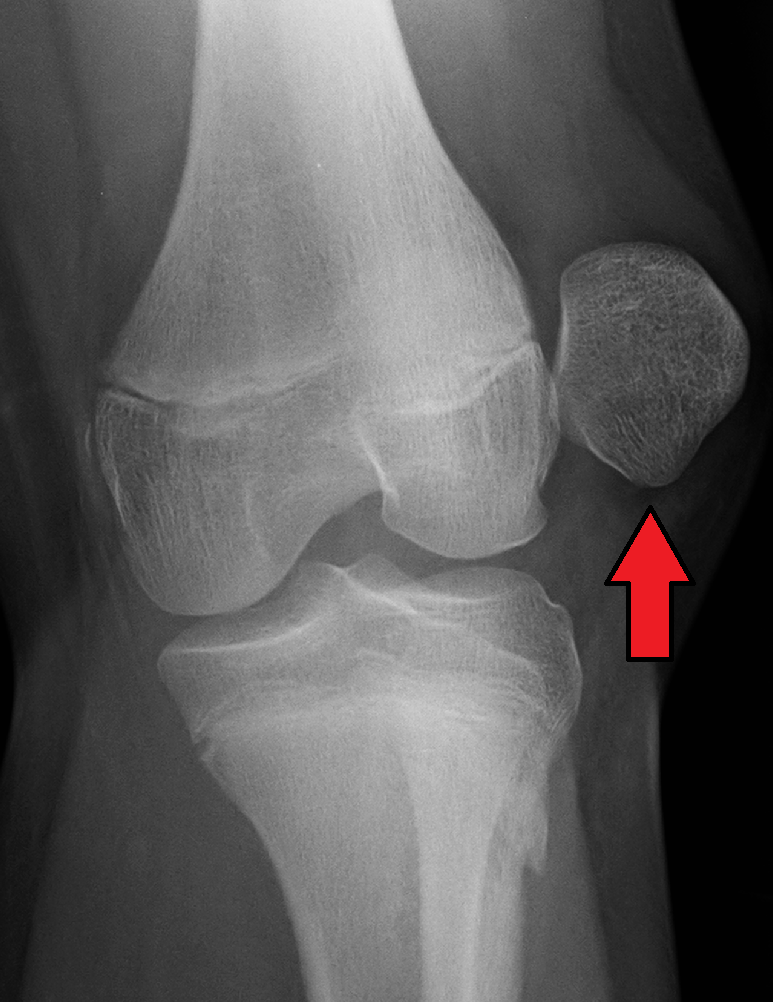
- Patella unossified until about 3 to 5 years
- Ultrasound or MRI needed for diagnosis in infants
- Radiographs later confirm lateral patellar position and trochlear dysplasia
Differential Diagnosis
- Habitual or obligatory patellar dislocation in flexion
- Recurrent patellar instability
- Congenital knee dislocation
Management
- Surgery early, in infancy or early childhood
- Extensive lateral release including ITB
- Quadriceps mobilisation and lengthening
- Medial plication or imbrication
- Distal realignment by soft tissue procedure such as Roux Goldthwait patellar tendon transfer
- Avoid tibial tubercle osteotomy with open physes
Complications
- Recurrent dislocation
- Residual flexion contracture or extension lag
- Patellofemoral arthritis
Reviewed by Professor Phong Tran, Head of Orthopaedic Surgery, Western Health. Last updated 10 October 2026.