
Definition
- Pathological tibia vara from disordered growth of the posteromedial proximal tibial physis
- Progressive varus with internal tibial torsion and procurvatum
Aetiology
- Excess compressive load inhibits medial physeal growth (Hueter Volkmann principle)
- Risk factors are obesity, early walking, African ancestry and family history
Epidemiology
- Infantile form begins before 4 years and is often bilateral
- Juvenile form begins at 4 to 10 years
- Adolescent form begins after 10 years, is usually unilateral and occurs in heavy children
Clinical Features
- Suspect when bowlegs persist beyond 2 years or progress
- Lateral thrust of the knee in stance phase
- Palpable medial metaphyseal beak
- Leg length discrepancy in unilateral disease
Investigations
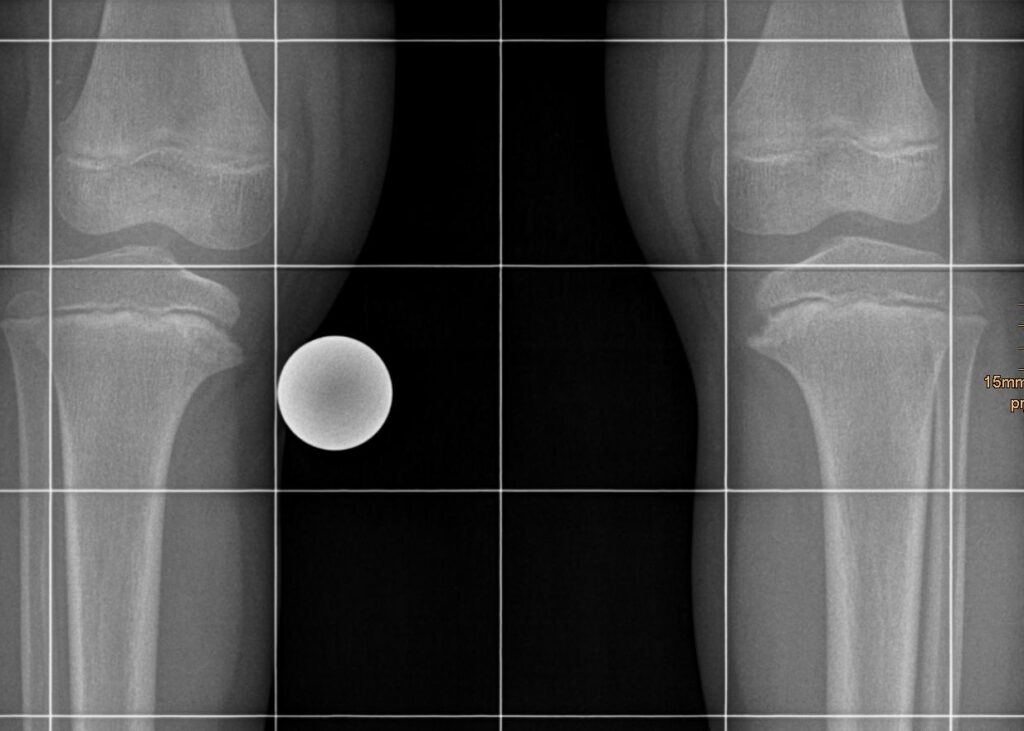
- Standing long leg AP radiograph
- Metaphyseal diaphyseal (Drennan) angle under 10 degrees suggests physiological bowing
- Drennan angle over 16 degrees suggests Blount disease
- MRI shows medial physeal bar and depression of the medial plateau
Classification
Langenskiöld (infantile)
| Stage | Radiographic features |
|---|---|
| I | Irregular medial metaphyseal ossification with beaking |
| II | Saucer shaped depression of the medial metaphysis with a step |
| III | Deeper step with the medial epiphysis sloping into the defect |
| IV | Medial epiphysis fills the metaphyseal depression |
| V | Cleft dividing the medial epiphysis (double epiphysis) with articular depression |
| VI | Bony bar across the medial physis |
Original publication Langenskiöld A. Tibia vara; (osteochondrosis deformans tibiae); a survey of 23 cases. Acta Chir Scand. 1952;103(1):1-22.
Differential Diagnosis
- Physiological genu varum
- Rickets
- Skeletal dysplasia
- Post traumatic or post infective physeal arrest
Management
- KAFO bracing for early infantile disease under 3 years
- Proximal tibial and fibular valgus derotation osteotomy before age 4 lowers recurrence
- Physeal bar resection for small bars in young children
- Lateral tension band plate guided growth in adolescents with growth remaining
- Gradual correction with circular or hexapod frame for large multiplanar deformity
- Medial plateau elevation osteotomy for severe late infantile disease
Complications
- Recurrence after osteotomy, more common in older children and advanced stages
- Compartment syndrome and peroneal nerve palsy after acute correction
- Prophylactic anterior compartment fasciotomy with acute osteotomy
Reviewed by Professor Phong Tran, Head of Orthopaedic Surgery, Western Health. Last updated 10 October 2026.