
Indications
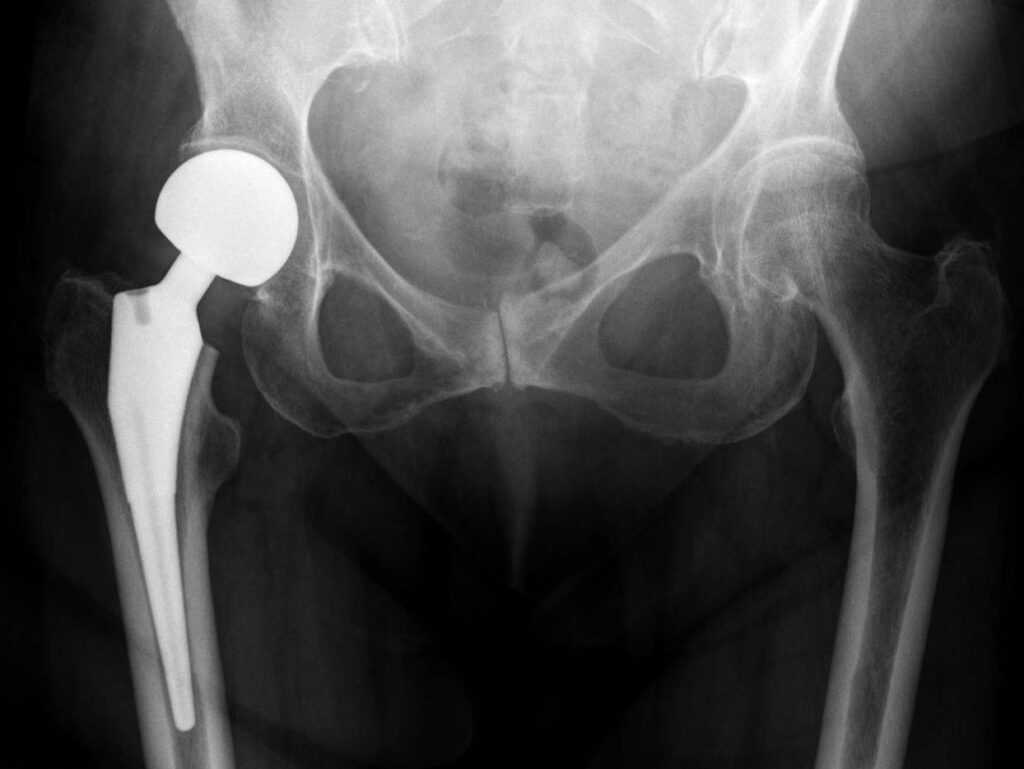
- Displaced intracapsular fracture in older lower demand patients
- Total hip replacement preferred for active, independent, cognitively intact patients
- The ACSQHC Hip Fracture Care Clinical Care Standard sets surgery within 48 hours of presentation
- Unipolar or bipolar head choice has little effect on outcome
Position
- Lateral decubitus
- Secure pelvic supports and pad pressure areas
Operative Steps
- Posterior approach with capsule and short external rotator repair, or anterolateral approach
- Remove the femoral head and measure its diameter
- Neck cut about 1 cm above the lesser trochanter
- Prepare the femur and trial for leg length, offset and stability
- Cemented stem reduces periprosthetic fracture and thigh pain (WHiTE 5)
- Cement with care given bone cement implantation syndrome risk
- Repair capsule and close
- Use an uncemented stem only if the patient cannot tolerate cementation
- Lavage and dry the canal and use a cement restrictor
- Communicate with the anaesthetist before cement insertion
Postoperative Care
- Full weight bearing
- Hip precautions as per approach
- Orthogeriatric care, VTE prophylaxis, osteoporosis treatment
- Mobilise on day 1
- Check haemoglobin and delirium screen
- Bisphosphonate or denosumab before discharge or at follow up
Complications
- Dislocation
- Periprosthetic fracture
- Bone cement implantation syndrome
- Acetabular erosion
- Acetabular erosion with time in active patients
- Delirium and medical complications
- 30 day mortality around 5 to 10%
Related Pages
Reviewed by Professor Phong Tran, Head of Orthopaedic Surgery, Western Health. Last updated 10 October 2026.