
Definition
- Fibrous, cartilaginous or bony bridge between two or more tarsal bones
- Failed mesenchymal segmentation
- Often autosomal dominant
Epidemiology
- Prevalence around 1%
- Bilateral in up to half
- Calcaneonavicular and talocalcaneal are the most common
- Talonavicular and calcaneocuboid are rare
- Associated with fibular hemimelia and Apert syndrome
Clinical Features
- Symptoms start as the coalition ossifies
- Calcaneonavicular presents around 8 to 12 years
- Talocalcaneal, usually middle facet, presents around 12 to 16 years
- Activity-related hindfoot or midfoot pain
- Recurrent ankle sprains
- Rigid flatfoot, with heel valgus not correcting on tiptoe
- Restricted subtalar motion
- Peroneal spastic flatfoot with painful peroneal spasm holding eversion
Investigations
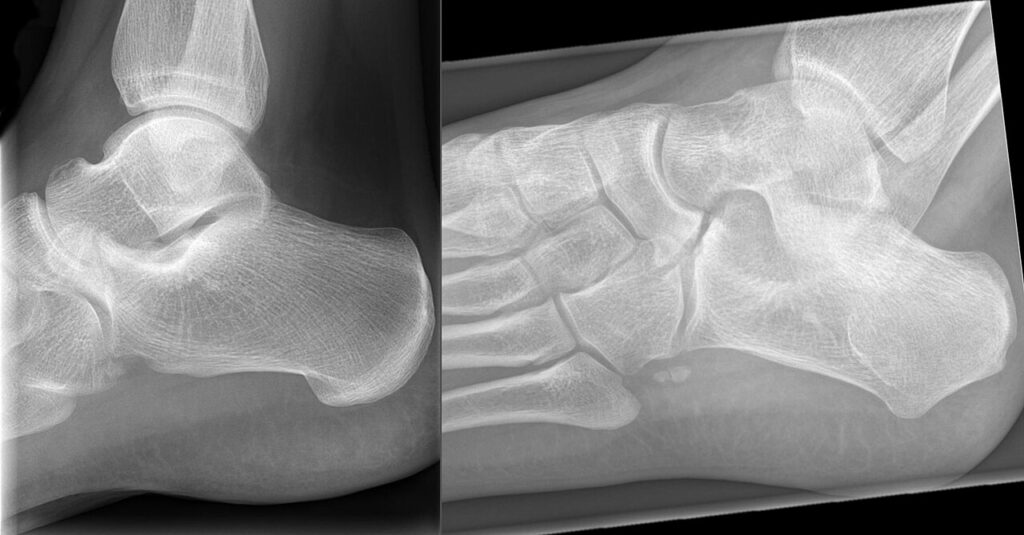
- AP, lateral and 45° internal oblique foot views, plus Harris axial heel view
- Calcaneonavicular coalition best seen on the oblique view
- Anteater sign on the lateral is an elongated anterior calcaneal process
- C sign, from medial talar dome and inferior sustentaculum, indicates talocalcaneal coalition
- Talar beaking is a secondary sign of abnormal subtalar motion and does not indicate arthritis
- Narrow posterior facet and absent middle facet suggest talocalcaneal coalition
- CT defines bony coalitions, size relative to the posterior facet and multiple coalitions
- MRI identifies fibrous and cartilaginous coalitions
Management
- Activity modification, analgesia and orthoses first
- Below knee walking cast for several weeks may give lasting relief
- Calcaneonavicular, resection with EDB or fat interposition to reduce recurrence
- Talocalcaneal, resection with fat interposition if small, without significant arthritis or severe valgus
- Coalitions over half the posterior facet do poorly after resection
- Calcaneal lengthening osteotomy for significant hindfoot valgus, with or without resection
- Subtalar or triple arthrodesis for large coalitions, arthritis or failed resection
Complications
- Recurrence
- Persistent pain
- Adjacent joint arthritis
Reviewed by Professor Phong Tran, Head of Orthopaedic Surgery, Western Health. Last updated 10 October 2026.