
Question
A 78 year old woman falls onto her outstretched arm. Radiographs show a displaced four part proximal humerus fracture. She lives alone and is independent.
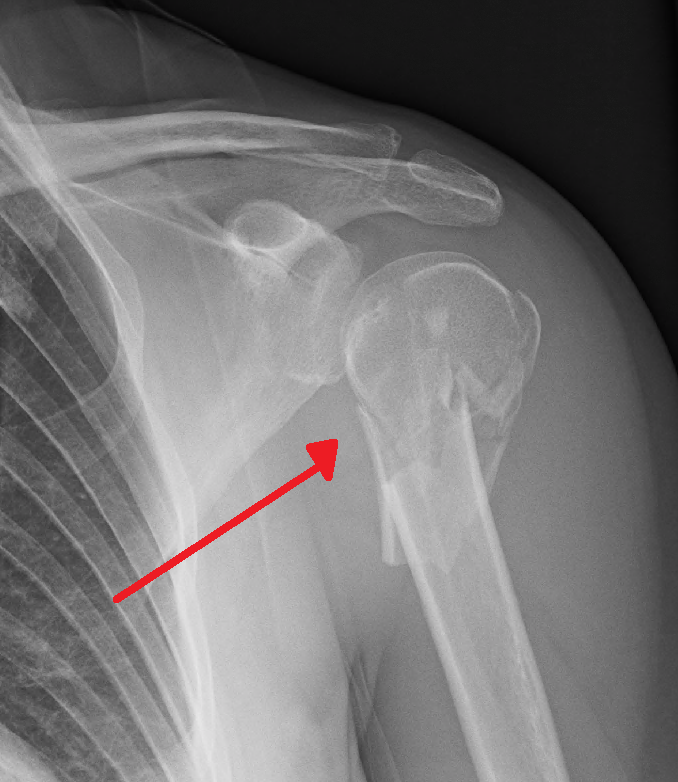
- How do you classify this injury?
- What factors predict humeral head ischaemia?
- What are the treatment options?
Answer
Classification
- Neer classification by the number of displaced parts (displacement over 1 cm or angulation over 45 degrees) among the head, shaft and the two tuberosities
- AO/OTA 11 classification
- Valgus impacted four part fractures behave better than displaced fractures
Predictors of ischaemia (Hertel)
- Metaphyseal head extension under 8 mm
- Disrupted medial hinge, with displacement over 2 mm
- Anatomical neck fracture pattern
- Fracture dislocation and head split fractures
Treatment options
- Non-operative care in a sling with early pendular motion, which gives acceptable function in many older patients (ProFHER trial)
- Locking plate fixation with calcar screws and tuberosity sutures in good bone and a reconstructable fracture
- Reverse total shoulder arthroplasty for older patients with unreconstructable fractures, giving more predictable function than hemiarthroplasty
- Hemiarthroplasty depends on tuberosity healing and is now used less often
- Treat osteoporosis after the fracture
Related pages
Author Contributions
Orthofracs team
Reviewed by Professor Phong Tran, Head of Orthopaedic Surgery, Western Health. Last updated 10 October 2026.