
Question
A 25 year old cyclist falls onto the point of his shoulder. There is a step at the acromioclavicular joint, and radiographs show the clavicle displaced superiorly by twice the width of the shaft.
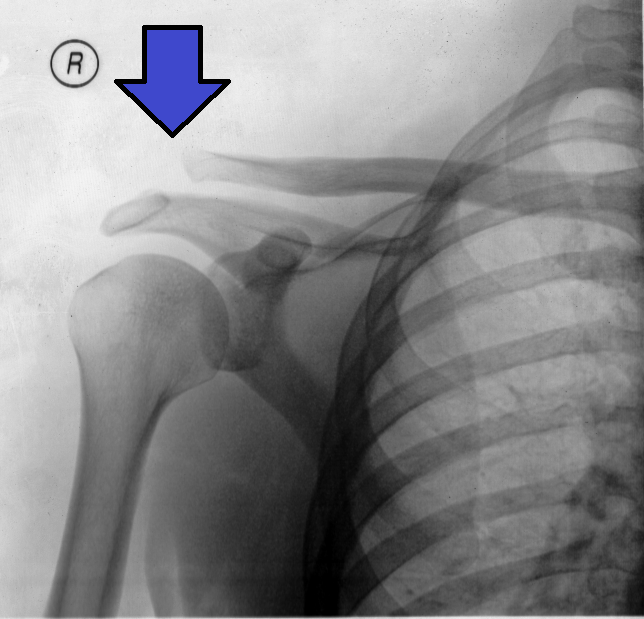
- How are these injuries classified?
- What would you look for on examination and imaging?
- How would you manage this patient?
Answer
Classification (Rockwood)
| Type | Features |
|---|---|
| I | AC ligament sprain, no displacement |
| II | AC ligament torn, CC ligaments sprained, under 25% displacement |
| III | AC and CC ligaments torn, 25 to 100% displacement |
| IV | Clavicle displaced posteriorly through trapezius |
| V | 100 to 300% superior displacement with deltotrapezial fascia stripped |
| VI | Clavicle displaced below the coracoid |
Examination and imaging
- Reducibility of the clavicle with shoulder shrug, which suggests intact deltotrapezial fascia
- Posterior displacement is best seen on an axillary view
- Zanca view (10 to 15 degrees cephalic tilt) and bilateral weighted comparison views
- Neurovascular examination and associated coracoid or clavicle fractures
Management
- Types I and II, sling and early motion
- Type III, most do well without surgery, with fixation considered for heavy manual workers, overhead athletes or persisting symptoms
- This injury is type V, so surgical reconstruction is usually recommended
- Acute repair with a suture button or hook plate, or reconstruction of the CC ligaments with tendon graft for chronic injuries
- Types IV and VI need open reduction and stabilisation
Related pages
Author Contributions
Orthofracs team
Reviewed by Professor Phong Tran, Head of Orthopaedic Surgery, Western Health. Last updated 10 October 2026.