
Question
A 45 year old man falls from a ladder. He has a closed humeral shaft fracture and cannot extend his wrist or fingers.
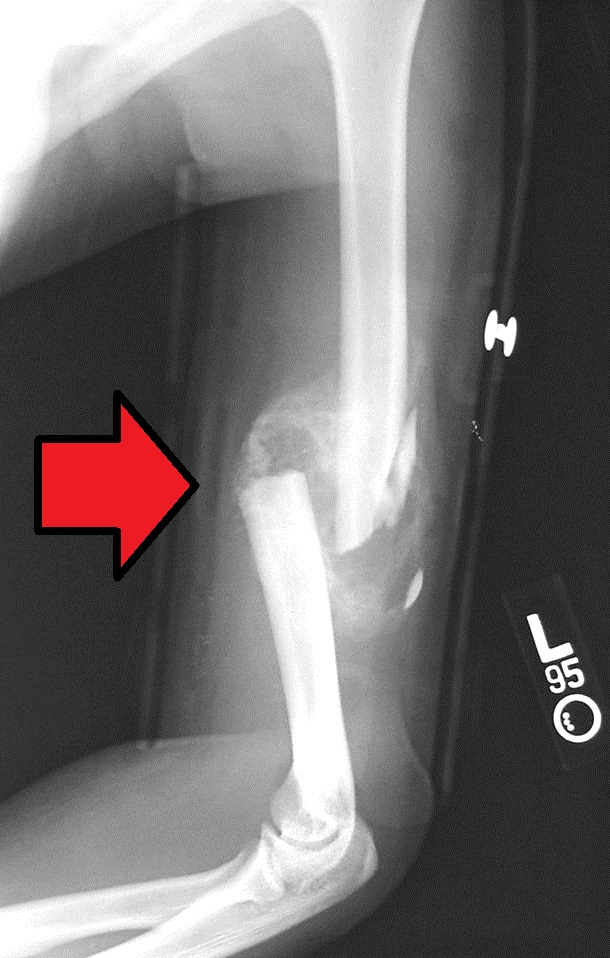
- How do you assess the nerve injury?
- What are the options for the fracture?
- How would you manage the nerve palsy?
Answer
Assessment
- Radial nerve palsy in about 12% of humeral shaft fractures
- Most are neurapraxia
- Holstein-Lewis spiral fracture of the distal third has a higher risk
- Test wrist and finger extension, thumb extension and first web space sensation
- Document function before any manipulation
Fracture management
- Functional bracing (Sarmiento) with union over 90%
- Tolerances, 20 degrees anterior angulation, 30 degrees varus, 3 cm shortening
- FISH trial showed faster recovery with surgery but similar function at one year
- Fixation for open fractures, vascular injury, floating elbow, polytrauma, pathological fractures and failed bracing
- Plate fixation or intramedullary nail, nailing has more shoulder pain
Radial nerve
- Closed injury, observe with a dynamic splint
- About 85 to 90% recover spontaneously
- Explore if open, if palsy appears after manipulation or if exposed during fixation
- Nerve conduction studies and EMG at 6 weeks to 3 months
- Exploration if no recovery by 4 to 6 months
- Brachioradialis recovers first
- Tendon transfers for failed recovery, PT to ECRB, FCR to EDC, PL to EPL
Related pages
Author Contributions
Orthofracs team
Reviewed by Professor Phong Tran, Head of Orthopaedic Surgery, Western Health. Last updated 10 October 2026.