
Question
A 17 year old boy has 6 months of thigh pain that wakes him at night and is relieved by ibuprofen. CT shows a small lucent nidus with surrounding sclerosis in the femoral cortex.
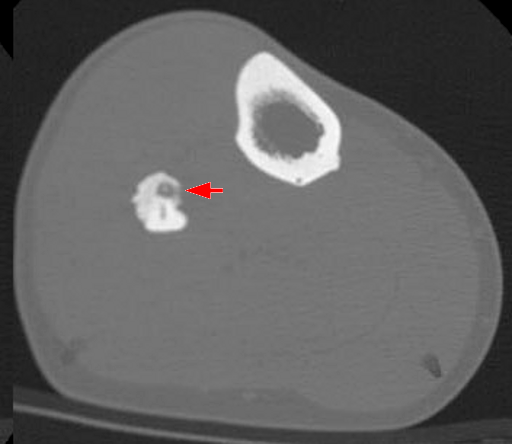
- What is the diagnosis?
- What are the differential diagnoses?
- What are the management options?
Answer
Diagnosis
- Osteoid osteoma, a benign bone forming tumour with a nidus under 1.5 to 2 cm
- Peak age 5 to 25 years, male predominance
- Night pain relieved by NSAIDs because the nidus produces prostaglandins
- Proximal femur and tibia most common, and spinal lesions in the posterior elements cause painful scoliosis
Differential diagnosis
- Osteoblastoma, larger than 2 cm with less NSAID response
- Brodie abscess
- Stress fracture
- Ewing sarcoma in the diaphysis
Investigations
- CT is the best test to show the nidus
- Bone scan shows intense focal uptake (double density sign)
- MRI often shows extensive oedema that can mislead
Management
- NSAIDs, as many resolve over 2 to 4 years
- CT guided radiofrequency ablation is the treatment of choice, with success over 90%
- Avoid ablation near skin, nerves and spinal cord
- Open excision of the nidus for lesions unsuitable for ablation
- Untreated spinal lesions can cause structural scoliosis
Related pages
Author Contributions
Orthofracs team
Reviewed by Professor Phong Tran, Head of Orthopaedic Surgery, Western Health. Last updated 10 October 2026.