
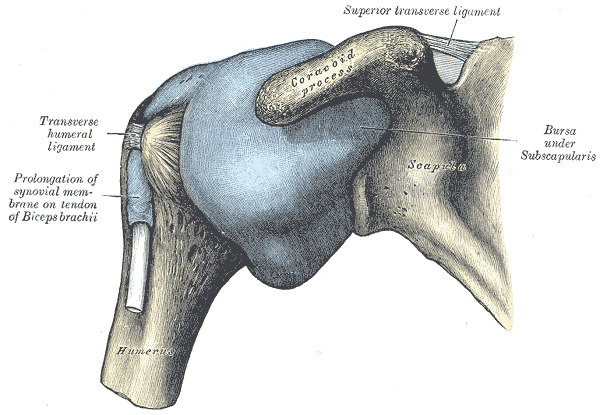
Indications
- Septic arthritis of the glenohumeral joint failing arthroscopic or needle lavage.
- Loculated or purulent joint needing open debridement.
- Adjacent osteomyelitis of the proximal humerus or glenoid.
- Arthroscopic lavage is an alternative for early infection.
Position
- Beach chair position at 30 to 45°, with a bump behind the scapula.
- Free draping of the arm to allow external rotation and extension.
Landmarks and Incision
- Palpate the coracoid process, clavicle and deltopectoral groove.
- Incise from just lateral to the coracoid along the groove towards the deltoid insertion.
Internervous Plane
- Deltoid (axillary nerve) and pectoralis major (medial and lateral pectoral nerves).
Superficial Dissection
- Identify the cephalic vein in the groove and retract it laterally with the deltoid.
- Retract pectoralis major medially.
- Incise the clavipectoral fascia lateral to the conjoint tendon.
- Retract the conjoint tendon medially, avoiding excessive traction.
Deep Dissection
- Externally rotate the arm to tension subscapularis.
- Ligate the anterior circumflex humeral vessels at the lower border of subscapularis.
- Divide subscapularis by tenotomy, peel or lesser tuberosity osteotomy.
- Incise the anterior capsule, then irrigate and debride synovium and fibrin.
Structures at Risk
- Axillary nerve at the lower border of subscapularis, protected by external rotation.
- Musculocutaneous nerve entering coracobrachialis, at risk from medial retraction.
- Cephalic vein.
- Anterior circumflex humeral vessels.
- Long head of biceps tendon in the groove.
Extension
- Extend distally along the groove to expose the humeral shaft, with the radial nerve at risk in the spiral groove.
- Extend proximally towards the clavicle.
Reviewed by Professor Phong Tran, Head of Orthopaedic Surgery, Western Health. Last updated 20 October 2026.