
Anatomy
- Branch of the upper trunk, root values C5 and C6
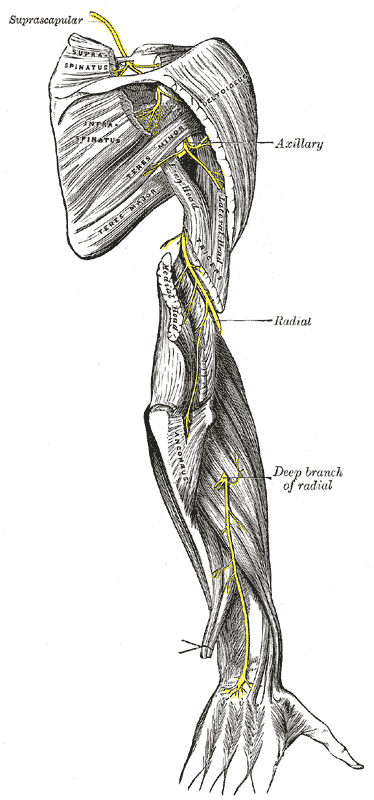
- Runs deep to trapezius to the suprascapular notch
- Passes beneath the superior transverse scapular ligament while the artery passes above it
- Supplies supraspinatus, then winds around the spinoglenoid notch to supply infraspinatus
- Lies about 2 cm medial to the posterior glenoid rim at the spinoglenoid notch
- Gives articular branches to the glenohumeral and acromioclavicular joints but no skin supply
Motor Supply
- Supraspinatus
- Infraspinatus
Clinical Features
- Compression at the suprascapular notch weakens both supraspinatus and infraspinatus
- Compression at the spinoglenoid notch affects infraspinatus alone
- Causes include a paralabral cyst from a SLAP tear, overhead sport such as volleyball, scapular fractures and traction from massive retracted cuff tears
- Deep posterior shoulder ache with wasting of the infraspinatus fossa
- Infraspinatus wasting is seen in some asymptomatic elite volleyball players
Investigations
- MRI for a paralabral cyst
- Nerve conduction studies and EMG
Management
- Rest and rehabilitation for traction neuropathy in athletes
- Arthroscopic cyst decompression with labral repair
- Arthroscopic release of the superior transverse scapular ligament
- Suprascapular nerve block gives effective shoulder analgesia
Structures at Risk
- Posterior glenoid drilling and screws exiting posteriorly in Latarjet and glenoid fixation
- Medial mobilisation of retracted supraspinatus in cuff repair
Reviewed by Professor Phong Tran, Head of Orthopaedic Surgery, Western Health. Last updated 10 October 2026.