
Question
A 72 year old woman has pain in both buttocks and legs after walking 100 metres, relieved by sitting and bending forward.
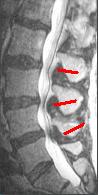
- What is the diagnosis and how would you distinguish it from vascular claudication?
- What imaging would you request?
- Outline your management.
Answer
Diagnosis
- Neurogenic claudication from lumbar spinal stenosis, most often at L4 to L5
- Central, lateral recess or foraminal narrowing from disc bulge, facet hypertrophy and ligamentum flavum thickening
Neurogenic versus vascular claudication
| Feature | Neurogenic | Vascular |
|---|---|---|
| Relief | Sitting or flexing forward | Standing still |
| Cycling | Tolerated | Provokes pain |
| Uphill walking | Easier | Harder |
| Pulses | Normal | Reduced |
| Skin | Normal | Trophic changes |
Imaging
- Standing lumbar radiographs with flexion and extension views for degenerative spondylolisthesis and instability
- MRI for the level and type of stenosis
- CT myelogram if MRI is contraindicated
- Ankle brachial index if vascular disease is suspected
Management
- Physiotherapy, weight loss and analgesia
- Epidural or nerve root injection for short term relief
- Decompression for disabling symptoms despite non-operative care, which gives better outcomes than continued non-operative care (SPORT)
- Add fusion when there is instability, such as degenerative spondylolisthesis with dynamic movement
Related pages
Author Contributions
Orthofracs team
Reviewed by Professor Phong Tran, Head of Orthopaedic Surgery, Western Health. Last updated 10 October 2026.