
Question
A 33 year old man dives into a shallow pool and strikes his head. He has neck pain and no neurological deficit.
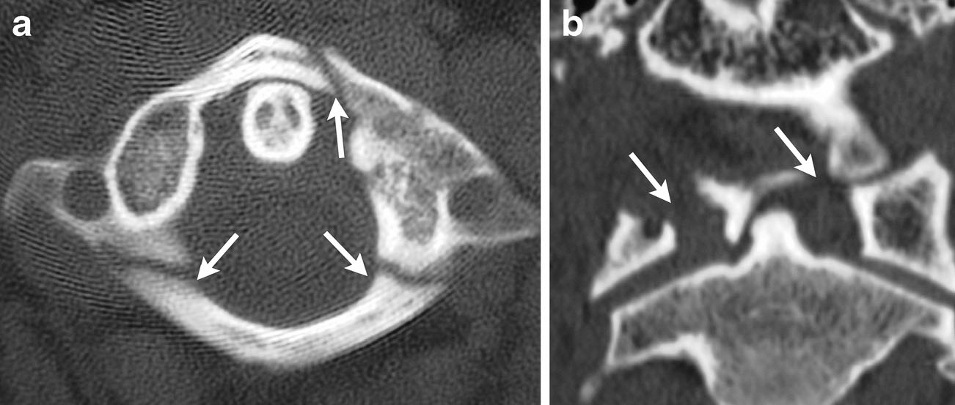
- Describe the CT and the mechanism.
- How do you assess stability?
- Outline management.
Answer
CT and mechanism
- Burst fracture of the ring of C1 with anterior and posterior arch fractures (Jefferson fracture)
- Axial load drives the occipital condyles into the lateral masses
- Fragments spread outwards, so neurological injury is uncommon
Stability
- Transverse atlantal ligament integrity decides stability
- Combined lateral mass overhang over 6.9 mm on the open mouth view (Spence rule) suggests TAL rupture
- MRI shows TAL rupture directly
- Dickman classification, type I midsubstance tear, type II bony avulsion
- ADI over 3 mm in adults suggests instability
- Exclude associated C2 fractures and vertebral artery injury (CTA)
Management
- Intact TAL, rigid collar for 8 to 12 weeks
- Dickman type II avulsions may heal in a halo or collar
- Dickman type I midsubstance tears need C1 to C2 fusion
- Halo for unstable injuries where fusion is declined
- Occiput to C2 fusion if lateral masses are destroyed
Related pages
Author Contributions
Orthofracs team
Reviewed by Professor Phong Tran, Head of Orthopaedic Surgery, Western Health. Last updated 10 October 2026.