
Question
A 52 year old woman had an olecranon fracture fixed after a fall. Two weeks later she reports pain over the wire.
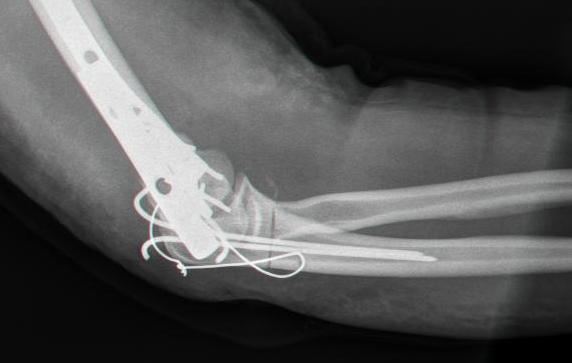
- What fixation has been used, and how does it work?
- What fracture patterns suit this method?
- What are the complications?
Answer
Fixation
- Tension band wiring with two longitudinal K-wires and a figure of eight wire
- Converts tensile force from triceps into compression at the articular surface
- Needs active elbow flexion to compress the fracture
Indications
- Transverse, non comminuted fractures (Mayo IIA)
- Plate fixation for comminution, oblique patterns, Monteggia variants and fracture dislocations
- Plate fixation for fractures distal to the coronoid
- Non-operative care or excision with triceps advancement for frail low demand patients
Mayo classification
| Type | Description |
|---|---|
| I | Undisplaced |
| II | Displaced, stable elbow (A non comminuted, B comminuted) |
| III | Displaced, unstable elbow |
Complications
- Symptomatic hardware, removal in up to 80%
- K-wire migration
- Anterior cortex perforation risks the anterior interosseous nerve and limits rotation
- Loss of reduction
- Ulnar nerve irritation
- Stiffness and loss of terminal extension
- Post-traumatic arthritis
Related pages
Author Contributions
Orthofracs team
Reviewed by Professor Phong Tran, Head of Orthopaedic Surgery, Western Health. Last updated 10 October 2026.