
Question
A 28 year old mountain biker falls onto his shoulder. He is a manual worker.
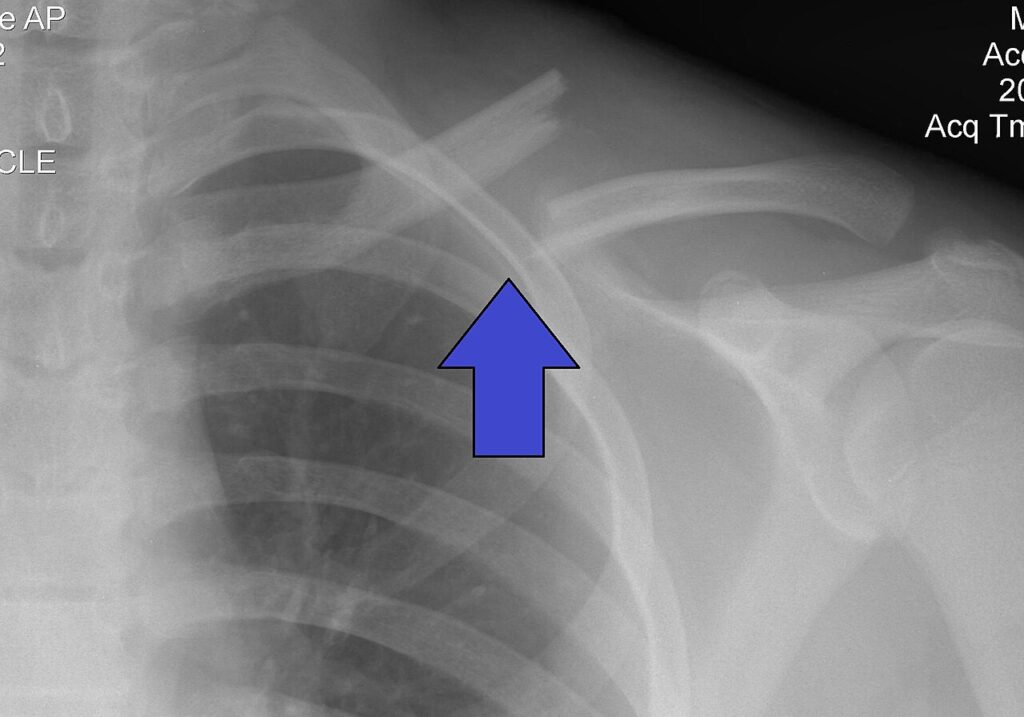
- Describe the radiograph and classify the injury.
- Discuss the evidence for operative versus non-operative treatment.
- What are the risks of fixation?
Answer
Description
- Displaced midshaft clavicle fracture
- Robinson type 2B (diaphyseal, displaced)
- Assess shortening, comminution and skin tenting
- Check neurovascular status and the chest for pneumothorax
Robinson classification
| Type | Location |
|---|---|
| 1 | Medial fifth |
| 2 | Middle three fifths (A undisplaced, B displaced) |
| 3 | Lateral fifth |
Evidence
- Canadian Orthopaedic Trauma Society (2007) showed lower nonunion and better early function with plating
- Nonunion after non-operative care of displaced fractures about 15%
- Robinson (2013) showed fewer nonunions with fixation but similar function at one year
- Many symptomatic malunions and nonunions do well with later fixation
- Relative indications are open fractures, skin compromise, floating shoulder, neurovascular injury, shortening over 2 cm and high demand patients
Risks of fixation
- Plate prominence and removal in up to a third
- Supraclavicular nerve numbness
- Infection and wound breakdown
- Subclavian vessel or brachial plexus injury from drilling
- Refracture after plate removal
Related pages
Author Contributions
Orthofracs team
Reviewed by Professor Phong Tran, Head of Orthopaedic Surgery, Western Health. Last updated 10 October 2026.