
Question
A 45 year old man has shoulder pain after an epileptic seizure. He holds the arm internally rotated.
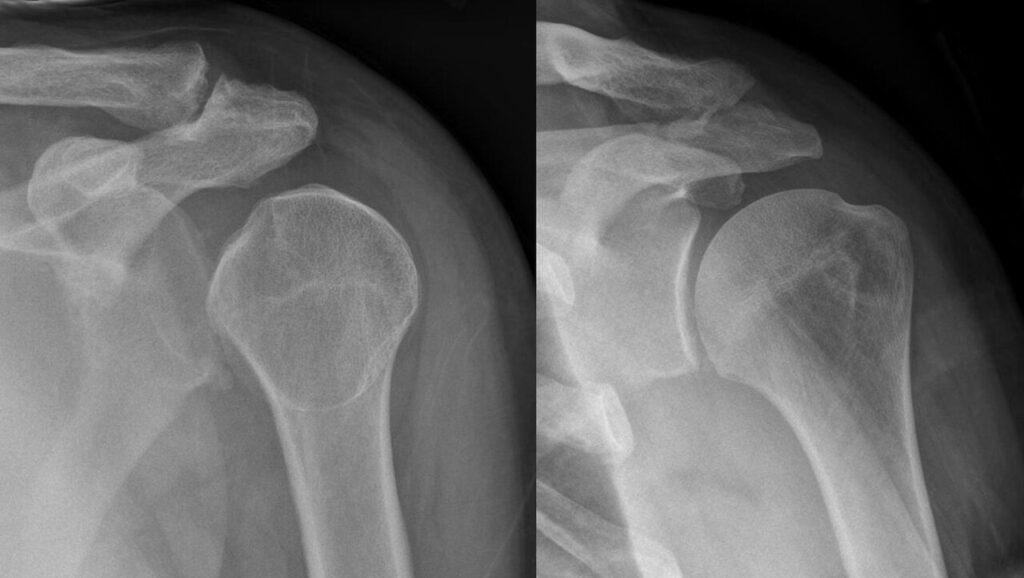
- What is the diagnosis and what signs are seen on the radiograph?
- How is it confirmed?
- How does the size of the humeral head defect guide treatment?
Answer
Diagnosis
- Posterior shoulder dislocation, missed in about half of cases at first presentation
- Caused by seizures, electrocution and high energy trauma
- Locked in internal rotation with no external rotation, posterior fullness and a prominent coracoid
Radiographic signs
- Lightbulb sign
- Loss of the normal half moon overlap
- Widened glenohumeral space (rim sign)
- Trough line from an impaction fracture
Confirmation
- Axillary or Velpeau view
- CT for the reverse Hill-Sachs lesion and associated fractures
Treatment by defect size
| Reverse Hill-Sachs defect | Treatment |
|---|---|
| Under 25 percent | Closed reduction and immobilisation in external rotation |
| 25 to 50 percent | McLaughlin procedure or allograft reconstruction |
| Over 50 percent or chronic | Arthroplasty |
Related pages
Author Contributions
Orthofracs team
Reviewed by Professor Phong Tran, Head of Orthopaedic Surgery, Western Health. Last updated 10 October 2026.