
Epidemiology
- Much less common than anterior
- < 5% of shoulder dislocations in most series
Classification
| Basis | Groups |
|---|---|
| Direction | Unidirectional, posterior (smallest group) Bidirectional, posterior & inferior Multidirectional |
| Cause | Traumatic Atraumatic Acquired (baseball pitching & swimming strokes) |
| Volition | Voluntary Involuntary |
Acute Posterior Dislocation
- Epidemiology
- Rare
- 2% of acute dislocations
- Often missed
- Aetiology
- Usually major trauma
- MVA
- Seizures
- ECT
- Electrocution
- Alcohol-related injuries
- Usually major trauma
- History
- History of injury
- Pain
- Stiffness
- Examination
- Loss of ER
- Internally rotated 40°
- Hold arm across chest
- Beware of young patient with arm across chest & limited ROM
- Don’t think frozen shoulder only
- Investigations
- X-ray
- AP
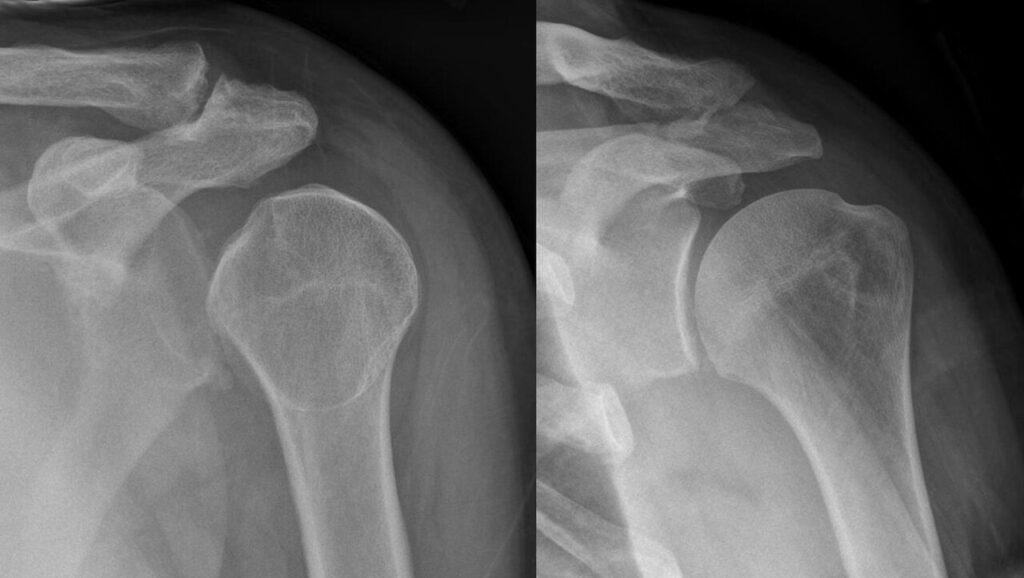
- Light bulb sign
- Globular head due to internal rotation
- Fracture of Lesser Tuberosity
- Axillary view
- Diagnostic
- May see reverse Hill-Sach’s
- AP
- CT Scan
- Confirms
- Quantifies humeral head defect
- Very important to decide management if locked
- X-ray
- Treatment
- Depends on
- Duration of dislocation
- Size of humeral head defect
- 1. Reduction
- Indications
- Duration < 6 weeks
- Reverse Hill-Sach’s defect < 25%
- Technique
- GA
- Traction with arm in extension & rotating to neutral position & then lifting the humeral head anteriorly into the glenoid
- May require open reduction
- Immobilise with Donjoy shoulder immobiliser in the Gunslinger Position (15° of ER)
- Indications
- 2. Stabilisation
- Indications
- Duration < 1 year
- Head defect 25-50%
- Technique
- McLaughlin procedure
- Delto-Pectoral approach
- Lesser tuberosity with attached subscapularis transferred into Reverse Hill-Sach’s lesion
- Renders defect an extra-articular problem
- If > 40% & young maybe use osteochondral allograft to fill defect
- McLaughlin procedure
- Indications
- 3.Hemiarthroplasty
- Indications
- Duration > 1 year
- Defect > 50%
- Ie. too big to stabilise but should avoid in the young
- Technique
- Neutral version rather than normal retroversion
- More stable to posterior instability
- Indications
- Depends on
Reviewed by Professor Phong Tran, Head of Orthopaedic Surgery, Western Health. Last updated 10 October 2026.