
Internal fixation aims for absolute stability with direct bone healing, using lag screws and compression plates for simple articular and diaphyseal fractures, or relative stability with callus healing, using nails and bridge plates for comminuted fractures. The AO principles are anatomical reduction, stable fixation, preserved blood supply and early motion.
Introduction
- Indications
- Principles of Internal Fixation
- Types of Internal Fixation
- Complications
Indications
- Failure to obtain or maintain fracture reduction
- 1. Irreducible fractures
- Fractures that cannot be reduced except by operation
- 2. Unstable fractures
- Fractures that are inherently unstable & prone to redisplacement after reduction
- 3. Fractures that unite poorly
- Principally fractures of the femoral neck
- 4. Pathological fractures
- Fractures in which bone disease may prevent healing
- 5. Multiple fractures
- Where fixation of one fracture facilitates treatment of the others
- 6. Fractures in patients who present nursing difficulties
- Eg. paraplegics, multiply injured patients, elderly
- 1. Irreducible fractures
Principles of Internal Fixation
- The aim of treatment is to produce stable fracture fixation, with a minimum of devascularisation, & early motion & partial loading
Principles (AO)
- 1. Anatomical reduction of the fracture fragments, particularly articular
- 2. Stable internal fixation
- 3. Preservation of the blood supply
- dependent on surgical technique
- 4. Early active pain-free mobilisation of muscle & joints
- (reduces joint contracture & loss of motion & dystrophy)
- Stable fixation
- Fixation that prevents motion of the fragments
- Stable fixation is best represented by a simple fracture with a rigid plate applied across the fracture in compression
- Introduction of compression introduces stability
- Compression allows the transfer of force from fragment to fragment rather than via the implant
- Stable fixation restores the load bearing capacity
- Compression 2 effects
- Produces preloading, maintaining close contact of the fragment surfaces
- Produces friction which resists transverse displacement & torque about the long axis
- Strain
- Relative deformation of a tissue » Displacement of fragments divided by the width of the fracture gap
- Represents the degree of instability
- At very low levels of strain the bone heals by primary healing
- At intermediate levels healing is by callus
- At high levels nonunion occurs
- Instability is best tolerated by multifragmentary fractures because the displacement is distributed over several interfaces & the individual strain is low
- Strain is very high for bone fragments separated by a single narrow gap & these fractures are very intolerant of even minute displacement
- This explains why in some situations where mobility has not been abolished (intramedullary nailing) the fracture heals while in other instances where only a very small gap is left even macroscopically invisible movement is not tolerated
- natural healing of bone tends to follow these principles in that concentric callus is formed about the fracture site producing a mechanical advantage & as the tissue differentiates a more rigid approximation of the fracture occurs
- At the same time resorption of the fracture ends occurs widening the interfragment gap & decreasing the strain value
Types of Internal Fixation
1. Lag screws
2. Plates
3. Intramedullary Nails
4. Tension Band Wiring
Lag Screws
- Stability is achieved by compression & bone contact
- Load transfer occurs directly from fragment to fragment & not via the implant
- Should be placed perpendicular to the fracture line
- Screw can apply 2000-4000N
- Drilling & insertion of a lag screw stimulates bone formation around the threads & maximum strength is reached at 6-8 weeks & at all times remains higher than when inserted
- One screw is never strong enough to achieve stable fixation & 2-3 screws are required
Plates
Seven types
- 1. Neutralisation plate
- 2. Compression plate
- 3. Buttress plate
- 4. Bridging plate/ wave plate
- 5. Antiglide plate
- 6. Tension-band plate
- 7. Spring plate
Neutralisation Plate
- Protect lag screws from bending, shear, & rotation
- Eg. lateral malleolus fracture
Compression plate
- Applied to tension side of eccentrically loaded bone
- Can produce 600N compression (cf. 2000-4000N compression with lag screw)
- Plate should be overbent to produce compression on far side as well as near cortex
- Inner screws applied first
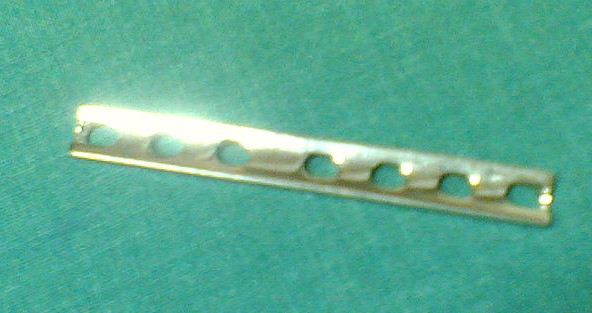
- Function of grooves on LCDCP
- Improve blood circulation by minimising plate-bone contact
- More even distribution of stiffness through the plate
- Allows small bone bridge beneath the plate
- Eg. transverse or short oblique radial fracture
Buttress plate
- Physically protects underlying thin cortex
- Often for metaphyseal fractures
- Eg. tibial plateau & distal radius fractures
Bridging plate
- Treatment of multifragmented fractures
- Bridge segment of comminution with indirect reduction & minimal disruption to blood supply
- Compression occasionally possible
- Eg. comminuted ulnar fracture
Antiglide plate
- Secured at apex of fragment of oblique fracture to physically block shortening or displacement
- Eg. Weber B ankle fracture with posterior plate
Tension-band plate
- Same principle as TBW with application on tensile surface of eccentrically loaded bone & conversion of tension forces to compression forces
- Eg. olecranon plate
Number of Cortices
- Humerus 6
- Radius & ulna 5
- Femur 7
- Tibia 6
Intramedullary Nail
Fixation of diaphyseal fractures of long bones
Types
- Reamed vs Unreamed
- Cylindrical vs Slotted
- Locked vs Unlocked
- Anterograde vs Retrograde
Examples
- Humeral nails
- Forsythe nails
- Femoral & tibial nails
- Long Gamma nails
- Expandable nails
Hollow nails associated with higher incidence of infection?
Tension-band Wiring
- Relies upon compression by the dynamic component of the functional load
- Conversion of tension forces to compression forces
- Allows some load-induced movement
- Patella & olecranon fractures
Bioabsorbable Materials
- Poly-lactic acid (PLA)
- Not induce bone reaction
- ~ 2 years to resorb
- Screws & wires available
- Poly-glycolic acid (PGA)
- Associated with cyst formation
- ? not used anymore
Complications
- Infection
- Nonunion
- Patient factors
- Injury factors
- Bone factors
- Surgical factors
- Implant failure
- Refracture
Reviewed by Professor Phong Tran, Head of Orthopaedic Surgery, Western Health. Last updated 10 October 2026.