
Definition
- Superior Labrum Anterior & Posterior
- Lesions of the Superior labral complex at biceps insertion
Aetiology
Two mechanisms 1. Compression force applied to GHJ
- Commonest
- FOOSH
- Arm in abduction & forward flexion
- Head subluxes superiorly over glenoid edge
- Detaches labrum by shear & compression
- Force ↑ by biceps co-contraction
2. Traction on Arm
- Sudden pull on arm
- Grab while falling
- Overhead motion
- Throwing
Epidemiology
- Young athletes involved in overhead throwing activities
- Most common in young males
- Often associated with rotator cuff tear or other pathology > 50%
Anatomy
- Superior labrum is meniscoid and loosely attached, more mobile than the inferior labrum
- LHB arises from the supraglenoid tubercle and superior labrum
- Normal variants include sublabral recess, sublabral foramen and Buford complex
- Buford complex is an absent anterosuperior labrum with a cord like MGHL
- Superior labrum has a poorer blood supply than the inferior labrum
- Biceps anchor resists anterior and superior translation in abduction and external rotation
Pathology
- Peel back torsion on the biceps in abduction and external rotation during late cocking
- Traction from eccentric biceps loading in the follow through phase
- Compression from a fall onto an outstretched arm in abduction and forward flexion
- Posterior capsular tightness with GIRD shifts the humeral head posterosuperiorly
- Internal impingement with articular sided cuff tears in throwers
- Paralabral cyst can compress the suprascapular nerve at the spinoglenoid notch
Classification
Snyder, based on arthroscopic findings
| Type | Description | Frequency |
|---|---|---|
| 1 Frayed | Fraying & degeneration of superior labrum. No detachment of labrum or biceps | 11% |
| 2 Detached | Superior labrum & attached biceps tendon stripped off glenoid. Differentiate from normal anatomy, as articular cartilage of glenoid normally extends to the attachment of labrum | 41% |
| 3 Bucket handle tear of superior labrum | Displacement of central rim of labrum into joint. Peripheral labrum & biceps tendon attached to glenoid | 33% |
| 4 Bucket handle involving biceps | Bucket handle tear of superior labrum with extension into biceps tendon, which remains attached but with partial tear |
Original publication Snyder SJ, Karzel RP, Del Pizzo W, Ferkel RD, Friedman MJ. SLAP lesions of the shoulder. Arthroscopy. 1990;6(4):274-9.
Added by Miller et al 1997
| Type | Description | Treatment |
|---|---|---|
| 5 Labral tear + SLAP (extension of type 2 further down labrum) | Anteroinferior Bankart lesion extending superiorly to separate the biceps anchor | Bankart repair extended superiorly to repair the biceps anchor |
| 6 Superior flap tear (like parrot-beak tear of meniscus) | Unstable anterior or posterior flap of superior labrum with biceps anchor separation | Flap debridement and repair of the biceps anchor |
| 7 Capsular tear + SLAP | Biceps anchor separation extending anteriorly beneath the MGHL | Superior labral repair and repair of the MGHL |
History
- Pain in shoulder with overhead activities
- Catching or popping with overhead activities
- mimic cuff tear
Examination
1. Speed’s Test Positive
2. McMurray’s Shoulder Test Positive
- Compression-Rotation test
- Patient supine
- Shoulder abducted 90°
- Elbow Flexed 90°
- Compression force to humerus
- Humerus rotated
- Attempt to trap torn labrum
- Positive if pain & click
3. Positive apprehension 39%, positive apprehension suppression 4%
Investigations
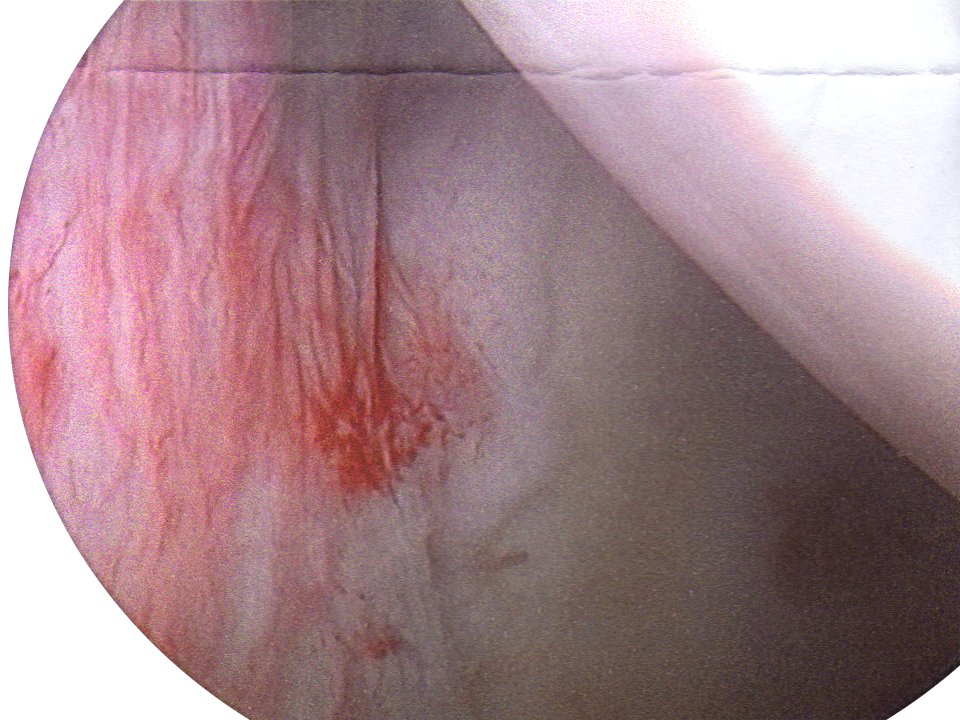
May be demonstrated on
1. CT-Arthrogram
2. MRI with Gadolinium
- Sensitivity 96% with arthrography
- Less with standard MR
- Buford complex normal variant
- Cordlike MGHL attaches to base biceps
- With absence of labral tissue
- Often missed or misdiagnosed
3. Arthroscopy
- Definitive diagnostic technique
Differential Diagnosis
- Rotator cuff tear or tendinopathy
- Subacromial impingement
- LHB tendinopathy or instability
- AC joint pathology
- Glenohumeral instability
- Internal impingement in throwers
- Suprascapular neuropathy
- Cervical radiculopathy
Treatment
Usually arthroscopic diagnosis
Treated at time of Arthroscopy
Consists of
- Shaving of frayed labrum
- Abrasion of superior rim of glenoid (encourages healing)
- Reattachment of superior labrum with bone tacks or sutures
- Biceps tenodesis to bicipital groove if significant biceps involvement
- Capsule repair if involved
Type 1 Debridement
Type 2 Debridement & fixation back to glenoid
Type 3 Debridement
Type 4 Debridement & possible biceps tenodesis
- If less than 30% of tendon involved: simply resect
- If > 30% tendon involved: biceps tenodesis to bicipital groove
Type 5 Stabilise both
Type 6 Debridement
Type 7 Repair & stabilise
Postoperative
- 4-5 weeks before active biceps strengthening
- No stressful biceps activity for 3 months
Results variable with satisfactory results up to 2 years
Maybe relationship with glenohumeral instability
Prognosis
- Return to sport after repair is lower in overhead athletes than other patients
- About 60% of overhead athletes return to their previous level after repair
- Biceps tenodesis gives better results than repair in older patients
- Postoperative stiffness is the commonest complication after repair
Reviewed by Professor Phong Tran, Head of Orthopaedic Surgery, Western Health. Last updated 10 October 2026.