
Overview
- Deltopectoral arthroplasty and open stabilisation need subscapularis takedown and repair
- Options are tenotomy, lesser tuberosity peel or lesser tuberosity osteotomy
- Failure causes weakness, anterior instability and poorer outcomes, most after anatomic TSR
- Test with lift off, belly press and bear hug
- Subscapularis sparing approaches in selected cases
- Protocols limit external rotation for about six weeks
Western Health Orthopaedic Registrar presentation – Subscapularis Management in Open Shoulder Surgery by Dr Marc-James Friso
Anatomy
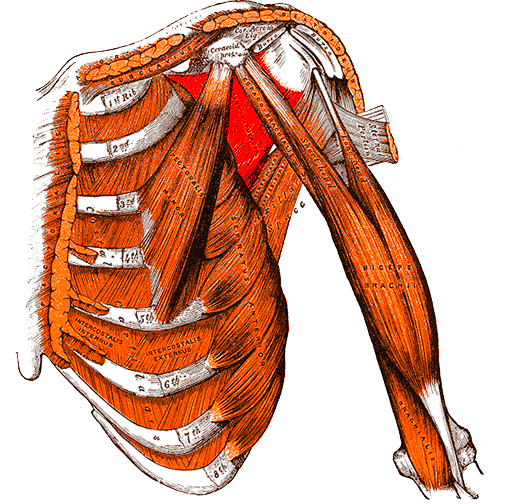
- Largest rotator cuff muscle, inserting on the lesser tuberosity
- Upper two thirds of the insertion tendinous, lower third muscular
- Upper and lower subscapular nerves (C5 and C6)
- Anterior humeral circumflex vessels (three sisters) mark the inferior border
Management
- Tenotomy about 1 cm medial to the insertion relies on tendon to tendon healing
- Peel off the lesser tuberosity allows a medialised repair to gain external rotation
- Lesser tuberosity osteotomy (LTO) gives bone to bone healing visible on radiographs
- LTO heals more often than tenotomy, with small differences in patient-reported outcomes
- A randomised trial of peel versus LTO found no functional difference
- In reverse arthroplasty, medialised designs dislocated more without repair, lateralised designs less so
- Sling for about 6 weeks, with external rotation limited to the safe range, around 30 degrees
- No active or resisted internal rotation or pushing up from a chair for 6 weeks
Complications
- Failure presents with anterior pain, weak internal rotation and increased passive external rotation
- Positive lift-off, belly press and bear hug tests
- Axillary radiograph shows anterior subluxation or LTO displacement
- Ultrasound, CT or MRI for tendon continuity
- Chronic irreparable deficiency may need pectoralis major or latissimus dorsi transfer
- Instability with an anatomical prosthesis is often revised to reverse arthroplasty
Reviewed by Professor Phong Tran, Head of Orthopaedic Surgery, Western Health. Last updated 10 October 2026.