
Definition
- Advanced G-H & A-C arthritis with complete cuff tear
- Called Milwaukee Shoulder in 1981 (associated with HA deposition disease) then
- Cuff Tear Arthropathy in 1983
Pathophysiology
- Glenohumeral instability leads to advanced arthritis after cuff integrity lost
- Rotator cuff prevents deltoid from elevating the head through compressive action
- With Rotator Cuff loss, there is Progressive narrowing of the subacromial space with humeral head ascent
- Coracoacromial arch is the secondary static stabiliser to humeral head migration
Pathogenesis
- Initially loss of the cuff integrity through degeneration is tolerated
- However as the superior forces exceed the medially directed forces the abrasive wear of cuff on acromion leads to buttonholing of head through the cuff
- Articular surface of humerus abraded on undersurface of the acromion
- The superiorly subluxed head has point contact on the superior glenoid
- Particulate debris fills the joint with synovitis & effusion
- subcutaneous fluid particularly superior to the AC joint
- presence of cuff tear does not always indicate arthropathy if the force couples balanced across the humeral head
History
- Unrelenting pain with referral to mid arm
- Sharp pain with crepitus in overhead activities
- Night pain significant
Examination
- Effusion & SS / Deltoid atrophy common
- Pain & crepitus with movement & loss of external rotation classical
Investigations
- X-ray
- Osteopenia
- Superior humeral head migration
- Narrowing of AC interval
- Severe erosions of the AC joint
- Subchondral sclerosis
- Cyst formation
- Osteophytes
- Loss of tuberosity prominence
- “ Acetabularisation of glenoid “ & “ Femoralisation “ of the humeral head
Operative Treatment
Arthroplasty
Indications
- Pain unresponsive to nonoperative care
- Grade 4 deltoid power
- The coracoacromial arch should be intact
Contraindications
- Weakened or absent anterior deltoid
- Active or suspected sepsis
Hemiarthroplasty with Large Head
- Pollock compared TSR & Hemi in cuff arthropathy & found pain relief better with hemiarthroplasty
- When the deltoid adequate & coracoacromial arch intact then procedure of choice
- Use large head to limit migration & allow articulation with the coracoacromial arch
Total Shoulder Arthroplasty
- Glenoid component loosening
- high incidence of lucent lines
- superior migration of head lead to eccentric forces at the glenoid margin & loosening
- “Rocking-Horse“ Phenomena
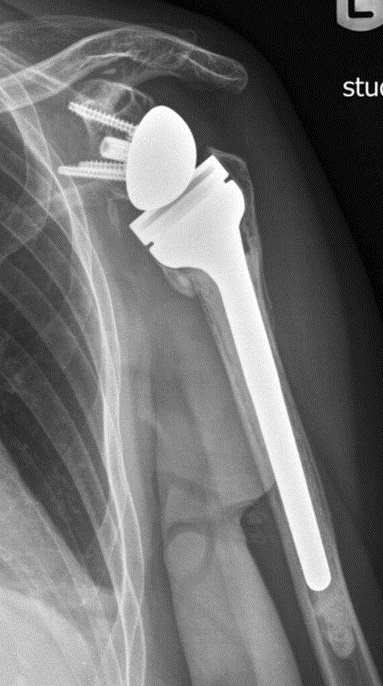
Reverse Total Shoulder Replacement
- good short term results
- concerns regarding longevity
- increasing popularity
Reviewed by Professor Phong Tran, Head of Orthopaedic Surgery, Western Health. Last updated 10 October 2026.