
Adhesive Capsulitis
Definition
- Idiopathic inflammatory condition characterised by progressive shoulder pain & stiffness that spontaneously resolves
- Restriction of GHJ movement in all planes
Epidemiology
- 40-60 years
- Women 2:1
- Non-dominant limb more affected
- Bilateral in 10-40%
- 2% of population
- 11% of diabetic population
- Sedentary workers ↑
Aetiology
- Poorly understood
- Autoimmune theory proposed but not proven
Predisposing Factors
- Immobility
- Trauma (often trivial)
- Cervical disc disease
- Diabetes Mellitus
- 10-20% compared with 2% of general population
- Bilaterality ↑ (40%)
- > 10 years of IDDM ↑ risk
- Thyroid disorders
- Hyperthyroidism
- Resolves with treatment of disease
- Myocardial infarction
- Intrathoracic disorders
- TB
- Carcinoma
- Emphysema
- Intracranial Pathology
- Hemiplegia
- Cerebral Haemorrhage
- Cerebral tumours
- Personality disorder
Not Associated with
- Osteoarthritis
- Cuff Pathology
Classification
Lunberg
- Primary
- Secondary
Apley
Three phases each lasting 4-8 months
| Phase | Features |
|---|---|
| Freezing | Increasing pain |
| Frozen | Decreasing pain, increasing stiffness |
| Thawing | Decreasing stiffness |
Pathogenesis & Pathology
Initial synovitis of unknown cause
- Results in
- Capsulitis
- Intra-articular adhesions
- Obliteration of inferior axillary fold
- Subsequent development of
- Subacromial adhesions
- Rotator cuff contracture
- Then spontaneous resolution
- Contracted, thickened joint capsule drawn tightly around the humeral head with relative lack of synovial fluid
- See cellular changes of inflammation with fibrosis & perivascular infiltration in subsynovial layer of capsule (Nevaiser) – similar appearance to Dupuytren’s disease
- Poor correlation between the microscopic & gross capsular changes
- Capsular folds & pouches obliterated by synovial adhesions
- Coracohumeral ligament is shortened & prevents ER
- Rotator cuff bellies contracted fixed & inelastic
- Few adhesions in subacromial bursa
- Spontaneous resolution the rule
Three Classical Stages (Apley)
| Phase | Features | Duration |
|---|---|---|
| Freezing | Gradual diffuse onset shoulder pain, lateral to arm at deltoid insertion. Worse at night & lying on that side. If reduce movement the pain reduced | Variable, 2-9 months |
| Frozen | Slowly progressive loss of shoulder movement with gradual subsidence of pain. Affects ADLs usually. Usually characteristic loss of ER & abduction. 10% have negligible glenohumeral movement | 4-12 months |
| Thawing | Gradually regain shoulder movement. Slow ↑ in movement with loss of discomfort | 6-9 months to regain functional ROM |
Clinical Features
History
- Insidious onset
- No history of trauma
Pain
- Initially
- At site of deltoid insertion
- At extremes of motion
- Becomes more
- Diffuse
- Severe
- Constant
- Interferes with sleep
- Then begins to decrease
- Rest pain disappears
- Pain only on movement
Stiffness
- Develops after onset of pain
- Difficulty reaching
- Overhead
- Behind back
- Activities modified
- Then stiffness slowly resolves
Examination
- Muscle atrophy
- No point tenderness
- Markedly ↓ ROM, especially
- Abduction
- Rotation
- Pain on forced movement
- Most sensitive indicator is pain on forced external rotation
- Scapulothoracic movement substituted for glenohumeral movement
Investigations
Plain Radiography
- Rule out other conditions
- Usually normal but may see relative osteopaenia
Bone Scanning
- May show diffuse ↑ uptake in shoulder
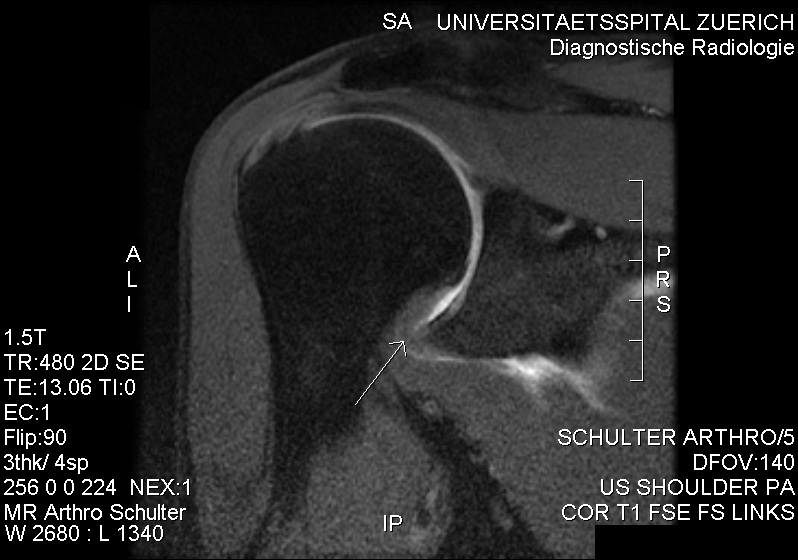
Arthrography
- Reduced volume < 10mls (normal shoulder 20-30ml)
- Obliterated axillary capsular recess
- Irregular joint outline
- Variable filling of the bicipital tendon sheath
- 6-20% have normal arthrogram
Arthroscopy
- Technically demanding due to small capsule
- Synovitis often present with obliteration of the inferior recess
- Nevaiser suggested four stagesStage I – Mild reddened synovitisStage II – Acute synovitis with adhesion of dependent foldsStage III – Maturation of adhesionsStage IV – Chronic adhesions
Differential Diagnosis
- GHJ Osteoarthritis
- Rotator cuff tear
- Missed Post-GHJ Dislocation
- RSD
- AVN
Treatment
Non-operative
Primary consideration is prevention
- Early ROM after trauma or surgery
- Educate care-givers
- Supportive care primary goal
Reassurance as first treatment
HCLA 2nd line
Avoid physiotherapy as makes it more painful & doesn’t ↑ ROM
Supportive
- Careful explanation of
- Nature of disease
- Natural history
- Reassurance
Freezing Phase
Directed towards pain relief
- Simple Analgesics / NSAID
- Sedatives
- Sling
- Ice
- TENS
Physiotherapy & exercises of no benefit
- Can make pain worse
- Can be used to maintain strength of cuff & periscapular muscles?
Frozen Phase
- Encourage hand use to avoid RSD
- ? Consider Hydrostatic Distension at this stage if desperate
Thawing Phase
- Gentle ROM & strengthening
- ? MUA or Distension
Operative Treatment
MUA & Steroid Injection
- Controversial
- Technique (Nevaiser)
- At least after 6/12 » late Frozen or early Thawing
- GA
- Shoulder MUA to regain ROM “out – up – in”
- External rotation first
- Then abduction
- Then internal rotation in abduction
- Then HCLA
- Sensation of tearing is the axillary fold tearing on A/S
- Shoulder abduction 90° for 2/52
- Postoperative physiotherapy
- Results
- Uncertain if alters natural history
- Reports vary from
- Shorter rehabilitation time
- Decreased period of stiffness
- No ↓ in course of disease
- No benefit with significant complications
- Contra-Indications of MUA
- Osteopaenia
- Previous fracture or surgery
- PVD
- History instability
- Complications of MUA
- Humeral fractures & dislocations
- Cuff tears
- Increased inflammation & scarring
- Radial nerve palsy
Hydrostatic Distension
- Uncertain at what stage to use 😕 Frozen or Thawing
- Technique
- Needle into GHJ under LA
- Joint forcefully distended by injection
- 5ml LA
- 1ml Steroid
- Up to 40ml Saline
- Distension until capsule ruptures
- Sudden drop in resistance
- Immediate postoperative physiotherapy
- Results
- Immediate resolution of pain
- Normal functional ROM by 4/52
Other
- Arthroscopy*
- Open Capsulotomy
- Don’t release axillary pouch
*Capsule rent with MUA usually along anterior capsule & inferiorly through most of IGHL
Some surgeons now suggest controlled division of the capsule arthroscopically – ie MUA without the risk of fractures & dislocations
Problem is arthroscopic access in frozen shoulder
Prognosis
- Traditionally thought to be benign & self-limiting
- Resolves after 12-36/12
- Average 18 months (Chris Blenkin says 2-5 years is average)
- Maximum 10 years
- Most have no significant symptoms or functional restriction
- But not as benign as previously thought
- 20% have mild pain
- 30-60% have ↓ ROM
- Usually external rotation (limitation of ER to less than 60% of opposite)
- Treat aggressively to avoid Osteoarthritis
Reviewed by Professor Phong Tran, Head of Orthopaedic Surgery, Western Health. Last updated 10 October 2026.