
Definition
Pain and neurological dysfunction in the distribution of a cervical nerve root, from mechanical compression or chemical irritation of the root. Distinct from myelopathy (cord compression) and from referred somatic neck pain (non-dermatomal).
Anatomy
- 8 cervical roots, 7 cervical vertebrae.
- Roots exit above their correspondingly numbered pedicle to C7; C8 exits between C7 and T1.
- A C5-C6 lesion therefore affects the C6 root.
- Root sits in the inferior foramen; vulnerable to uncovertebral osteophyte anteriorly and facet osteophyte posteriorly.
- Foraminal area reduced by extension, ipsilateral side-bending and rotation. Increased by flexion and contralateral rotation.
Aetiology
- Spondylotic foraminal stenosis – commonest overall; usual cause >50 years
- Soft disc herniation – younger patients; usually posterolateral
- Less common – tumour, infection, synovial cyst, OPLL, inflammatory arthropathy
- Compression alone does not produce radicular pain; inflammatory mediators from the disc contribute
Epidemiology
- Annual incidence of the order of 80 per 100,000.
- Peak in the fifth and sixth decades.
- C7 most commonly affected, then C6; together ~75% of cases.
- Minority report preceding trauma or exertion.
Natural History
- Majority improve substantially within 6–12 weeks.
- Disc herniations frequently regress on follow-up imaging.
- Non-operative treatment appropriate first line in the absence of myelopathy or significant motor deficit.
- Minority follow a relapsing course or fail to settle.
History
- Neck and periscapular pain, then radiating arm pain in a dermatomal distribution; often worse at night
- Paraesthesia and numbness distally
- Weakness less commonly the presenting complaint
- Shoulder abduction relief sign – relief on placing the hand on the head
- Screen for myelopathy: gait, balance, hand dexterity, sphincter function
Examination
By Root Level
- C5 – deltoid, biceps; lateral arm; biceps reflex
- C6 – wrist extension, biceps; thumb and index; brachioradialis reflex
- C7 – triceps, wrist flexion, finger extension; middle finger; triceps reflex
- C8 – finger flexors, interossei; ring and little finger; no reliable reflex
- T1 – intrinsics; medial forearm
Provocative Tests
- Spurling – extension, ipsilateral rotation, axial compression. Specific, not sensitive.
- Upper limb tension test – sensitive; useful to rule out.
- Cervical distraction – relieves symptoms.
- Always examine for long tract signs.
Differential
- Rotator cuff pathology, cubital and carpal tunnel syndrome, brachial neuritis (Parsonage-Turner), thoracic outlet syndrome, peripheral neuropathy
Investigations
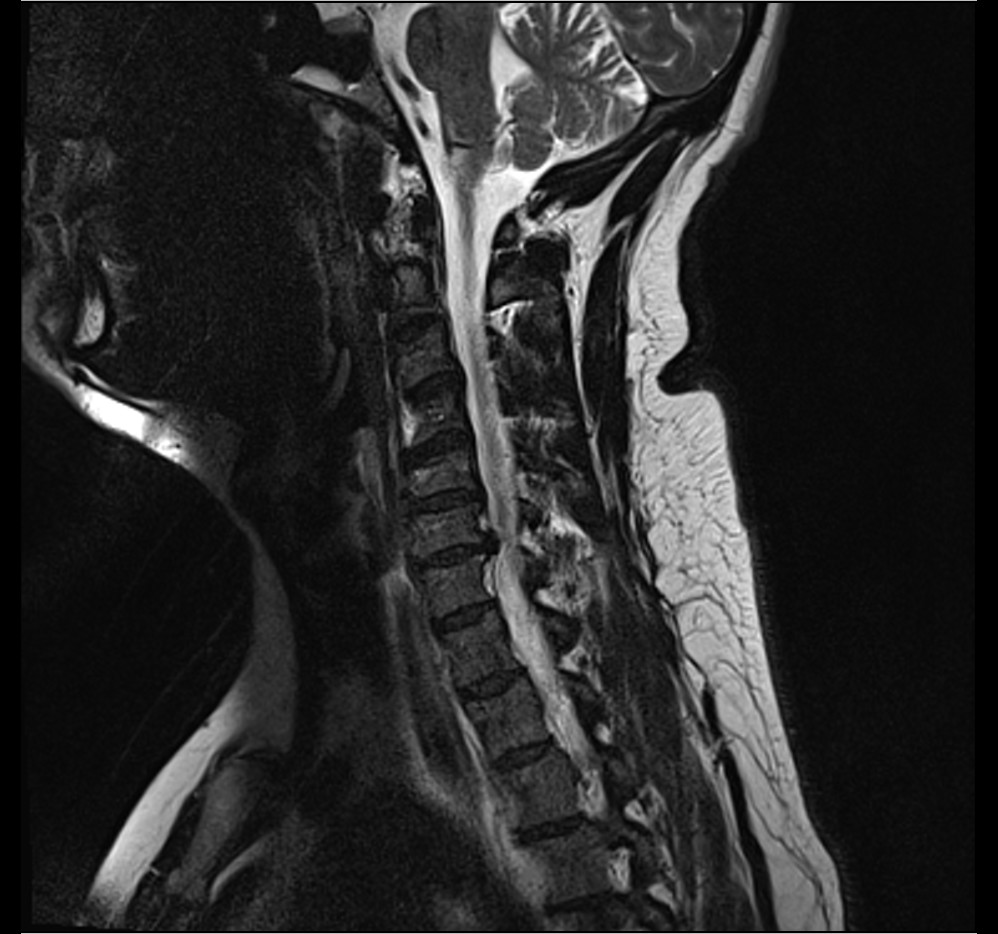
- MRI – investigation of choice. Degenerative change near-universal over 50; findings count only when they match the examined level.
- CT myelogram – MRI contraindicated, or bony foraminal stenosis needing definition
- Electrodiagnostic studies – equivocal cases; distinguishes radiculopathy from peripheral entrapment or plexopathy
- Plain radiographs including obliques – alignment, instability, foraminal narrowing
Treatment
Non-operative
- First line for all patients without myelopathy or progressive motor deficit
- Relative rest, analgesia, short course NSAID
- Structured physiotherapy including traction and manual therapy
- Short reducing course of oral corticosteroid
- Transforaminal or interlaminar epidural steroid injection for persistent radicular pain; recognised risks at cervical level
Indications for Surgery
- Progressive or significant motor weakness
- Radicular pain failing 6–12 weeks of appropriate non-operative treatment
- Any evidence of myelopathy
Operative Options
- ACDF – standard; addresses soft disc and uncovertebral osteophyte, corrects alignment. Costs the motion segment; adjacent segment degeneration.
- Cervical disc arthroplasty – younger patient, soft disc, preserved motion, no significant facet arthrosis or instability
- Posterior foraminotomy, open or endoscopic – motion preserving; posterolateral soft disc or foraminal stenosis. Does not address central disease or kyphosis.
Outcome
- Relief of arm pain more reliable than relief of neck pain. State this at consent.
References
- Woods BI, Hilibrand AS. Cervical radiculopathy: epidemiology, etiology, diagnosis, and treatment. J Spinal Disord Tech 2015. PubMed 25985461
- Cervical spine radiculopathy epidemiology: a systematic review. Musculoskeletal Care 2020. PubMed 32710604
- Nonoperative management of cervical radiculopathy. Am Fam Physician 2016. PubMed 27175952
- The course and prognostic factors of symptomatic cervical disc herniation with radiculopathy. Spine J 2014. PubMed 24614255
- Neurological examination for cervical radiculopathy: a scoping review. BMC Musculoskelet Disord 2025. PubMed 40188056
- Musculoskeletal mimics of cervical radiculopathy. Muscle Nerve 2022. PubMed 35466429
Reviewed by Professor Phong Tran, Head of Orthopaedic Surgery, Western Health. Last updated 10 October 2026.