
- AKA Clostridial Myonecrosis
Definition
- Life threatening, rapidly progressive, necrotising, gas-producing infection of skeletal muscle due to Clostridia
- Characterised by
- Massive muscle necrosis
- Gas production
- Due to invasive anaerobic Clostridial infection
- Clostridial infections are
- Cl perfringens (welchii)
- gas gangrene
- Cl tetani
- Cl botulinum
- botulism
- Cl difficile
- pseudomembranous colitis
- Cl perfringens (welchii)
Epidemiology
- Seen with
- Open fractures
- Penetrating wounds
- War & farmyard wounds
- Arterial insufficiency in an extremity
- Surgical wounds
- Bowel & Biliary surgery
- Poor technique
- USA 1000 cases/ year
- 0.05% of open fractures
- Need 3 things
- Necrotic tissue
- Especially buttock & thigh
- Ischaemia with low PO2
- Contamination with Clostridium perfringens or other histotoxic Clostridia
- Greatly ↑ by
- Poor debridement
- Poor antibiotics
- Primary wound closure
Aetiology
- Clostridium perfringens (welchii) 80%
- Clostridium novyi 15%
- Clostridium septicum 5%
Clostridium Perfringens
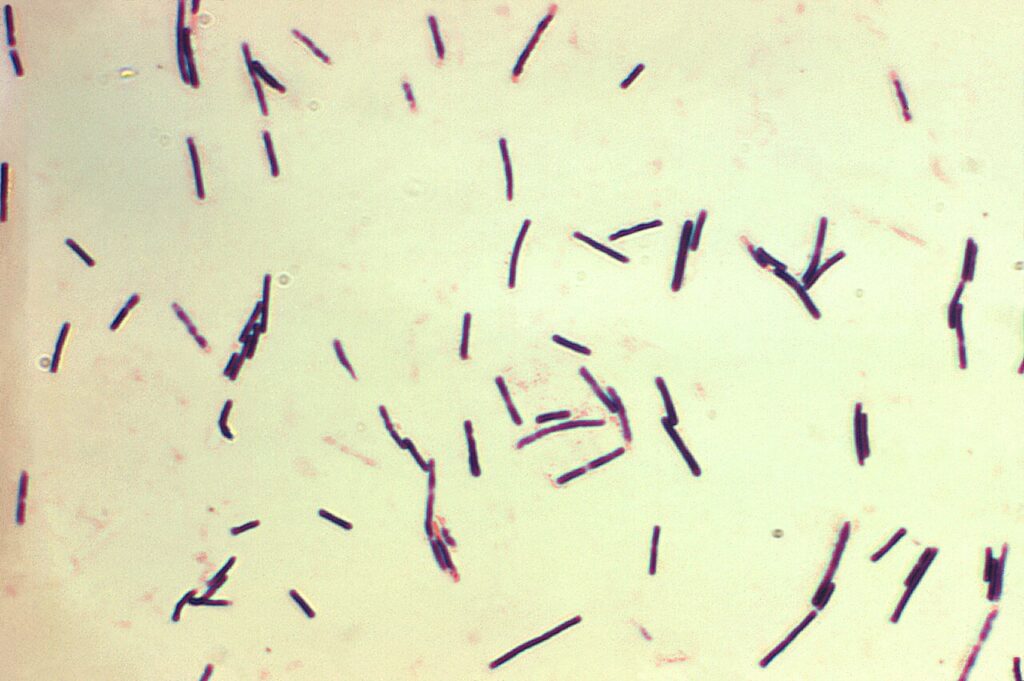
- Large gram positive bacillus
- Non-motile
- Encapsulated
- Obligate anaerobe
- Produces spores
- Found in soil & faeces
- Ubiquitous
- 20% of patients skin
- Saprophytic commensal of GIT
- Theatres & A&E
Exotoxins (Histotoxins)
- Production of large variety of toxins/ enzymes that result in myofascial spread
- Necrotising & Haemolysing nature
- Proteolytic or Sacrolytic
- Based on Nagler reaction
- Sweet or foul odour
- 9 types
- Most important is Alpha Toxin (Lecithinase)
- Others include
- Haemolysin
- Collagenase
- Hyaluronidase
- Leucocidin
- Deoxyribonuclease
- Protease
- Lipase
Vicious Cycle
- Necrotic closed wound is contaminated
- Clostridium colonization
- Low PO2
- Production of histotoxins
- Destruction of cell wall
- Local tissue death
- Further colonization
- Overwhelms WBC
- Further tissue destruction
Pathology
- Involved muscle rapidly undergoes disintegration & necrosis
- Initially pale, swollen & inelastic
- Later becomes discoloured & friable
- Reddish purple then
- Greenish purple & gangrenous
- Gas in tissues
- Histology shows coagulation necrosis
Clinical Features
- Incubation
- Usually ~ 2-3/7
- Can be as short as 6/24
Symptoms
- History muscle penetrating injury
- Earliest & most sensitive symptom is pain
- Pain/ heaviness out of proportion to injury or procedure
- Initially alert & anxious
- Later fearful of death
Signs
- General
- Pale & sweaty
- Moderate fever
- Marked tachycardia
- Hypotension & shock follows
- Delirium » Stupor » Coma » Death
- Wound
- Early
- Skin swollen & white
- Tense oedema & local tenderness
- Serosanguinous & brown discharge
- Foul or Sweet odour
- ± Crepitus due to gas
- Progress over 2-4 hours with advancing crepitus & oedema
- Later
- Bronze discolouration
- Blebs containing dark fluid
- Areas of green-black cutaneous necrosis
- Early
Investigations
- Clinical diagnosis only
Laboratory
- Positive blood culture in 15%
- Gram-stain of exudate
- Not diagnostic
- Many organisms » Large gram positive rods
- But few leukocytes & no spores
- Positive Nagler’s test
- Lecithinase turns egg yolk opaque in agar
X-ray
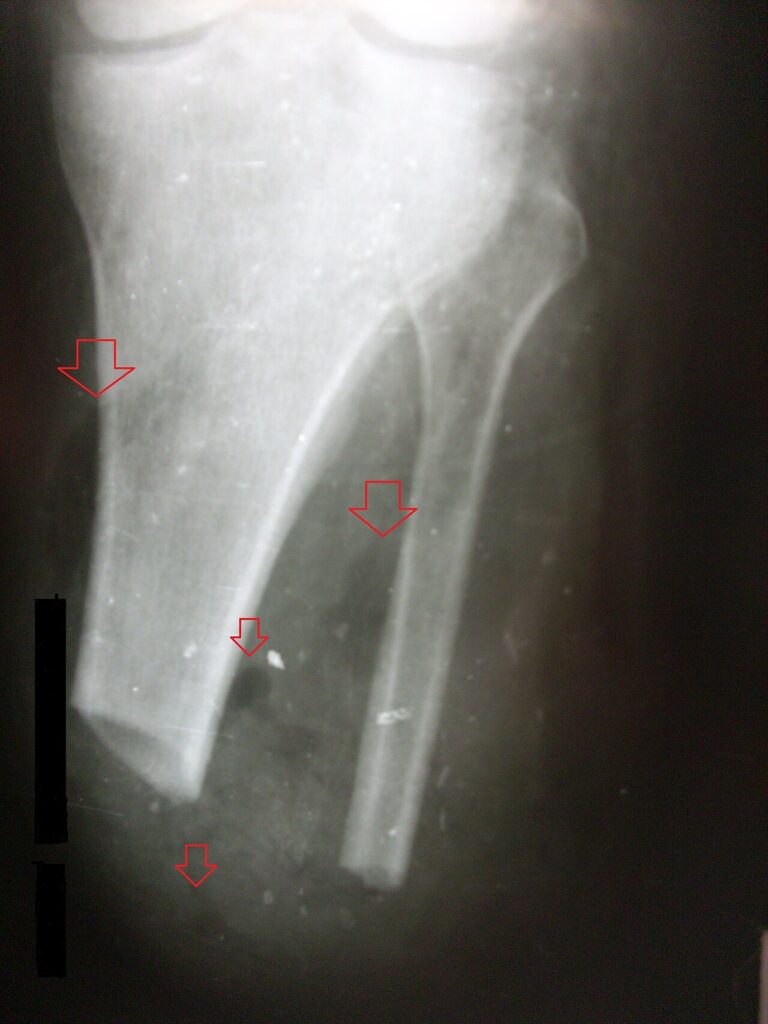
- Gaseous distension of muscle & fascial planes
Differential Diagnosis
- Pain with myonecrosis is the key
Anaerobic Clostridial Cellulitis
- Clostridial infection of necrotic soft tissue
- Onset > 3/7
- Poorly debrided wound
- Gradual onset
- Slight toxaemia & no pain
- Slight brown, seropurulent exudate
- No skin lesions
- Foul gas +++
- More than Clostridium myonecrosis
- No muscle invasion
Streptococcal Myonecrosis
- Group A ß Haemolytic Streptococcus
- S pyogenes
- “Flesh-eating bug”
- Similar to Clostridium myonecrosis
- Longer incubation period (> 3/7)
- Characteristic pain not present
- Little gas formation & profuse seropurulent discharge
Infected Vascular Gangrene
- Due to saprophytic Clostridia
- Proliferates & produces gas
- Gangrenous muscle
- Line of demarcation
- No acute toxaemia
- Can develop into Clostridial myonecrosis
Other Gas-Producing Organisms
- Coliform Bacteria
- Anaerobic Streptococcus
- Anaerobic Bacteroids
Prophylaxis
- Awareness
- Open fractures
- Deep penetrating injuries – buttock / thigh
- Early meticulous surgical debridement
- Leave wound open with no pack
- Appropriate AB
- Cephalothin
- + Gentamicin if extensive
- + Penicillin if farmyard, crush or vascular injury
Management
Surgery
- Most important
- Delay » Death
- Emergency exploration
- Examine muscles directly
- Differentiate Myonecrosis from anaerobic Cellulitis (crepitant cellulitis)
- Appropriate debridement
- Radical myoexcision
- Fasciotomies
- ± Amputation
Antibiotics
- Penicillin G 3MU (1.8mg) q3h IVI
- If allergic to penicillin
- Metronidazole
- Chloramphenicol
- Tetracycline 2-4g/ day
- Beware penicillin resistance (developing recently)
- If allergic to penicillin
- Gentamicin for co-infection with other organisms
- Cephalosporins less effective
Resuscitation
- Fluid loss +++
- Prompt replacement
- Monitor fluid balance
Hyperbaric O2
- Controversial
- 3 atmospheres for 60-90 minutes every 8-12 hours for 4-6 sessions
- Appears to allow peroxides to develop & so destroy organism
- Bacterostatic
- Bacterocidal
- Also appears to neutralise clostridial toxin
- May reduce extent of debridement required
- Hazards
- Barotrauma
- Decompression sickness
- Convulsions
- Otitis media
- Lung damage
- Useful where trunk involved
- Don’t delay debridement to transfer to hyperbaric chamber
Prognosis
- Mortality
- WWI – 50%
- WWII – 25%
- 50% if reaches trunk
Reviewed by Professor Phong Tran, Head of Orthopaedic Surgery, Western Health. Last updated 10 October 2026.