
Question
A 51 year old labourer presents with a 6 month history of a painful, weak shoulder after lifting a heavy box at work.
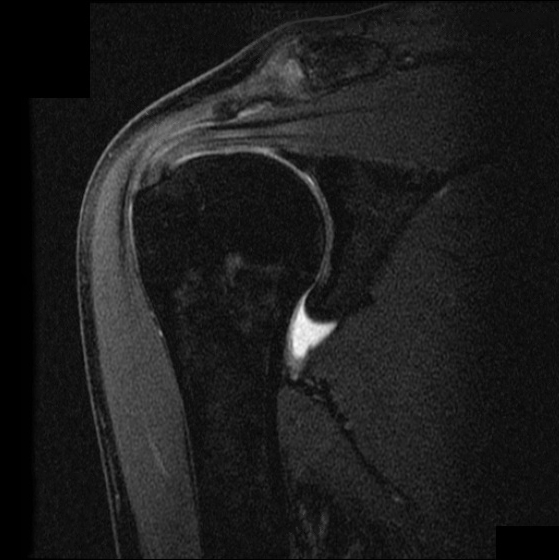
- Discuss your history, examination and requested imaging.
- What is the most likely diagnosis?
- Outline your management.
Answer
History
- Mechanism, onset of pain and weakness, night pain and difficulty with overhead tasks
- Hand dominance, occupation, workers compensation status and expectations
- Smoking, diabetes and previous steroid injections, which affect healing
Examination
- Wasting of supraspinatus and infraspinatus fossae
- Active and passive range, with a full passive range and weak active elevation suggesting a cuff tear
- Jobe empty can test for supraspinatus, external rotation lag sign for infraspinatus, lift off and belly press tests for subscapularis
- Impingement signs (Neer, Hawkins) and the cervical spine
Imaging
- True AP, axillary and outlet views for acromial shape, acromiohumeral interval and arthritis
- Ultrasound or MRI to show tear size, retraction (Patte), fatty infiltration (Goutallier) and muscle atrophy
Diagnosis
- Acute on chronic full thickness rotator cuff tear, most often of supraspinatus
Management
- Early repair for acute traumatic tears in active patients, ideally within about 3 months
- Arthroscopic or open repair with suture anchors, with or without subacromial decompression
- Sling for 4 to 6 weeks, passive motion first, then active motion and strengthening from about 12 weeks
- Retear risk rises with age, tear size, retraction and fatty infiltration
Related pages
Author Contributions
Orthofracs team
Reviewed by Professor Phong Tran, Head of Orthopaedic Surgery, Western Health. Last updated 10 October 2026.