
Question
A 13 year old obese boy has 6 weeks of left knee pain and a limp. He can walk with crutches. On examination the hip rotates externally as it is flexed.
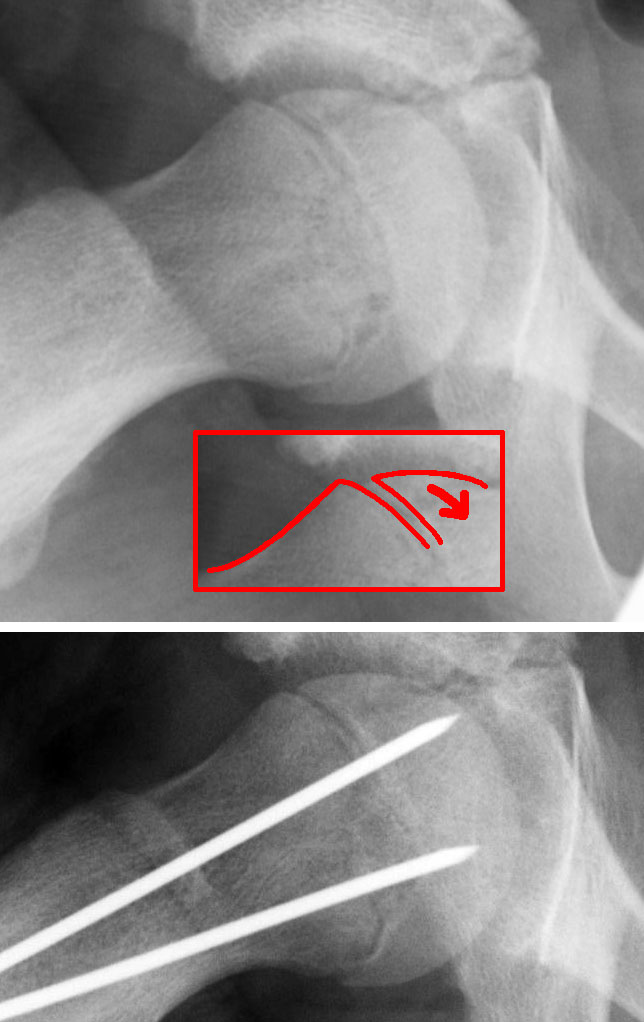
- What is the diagnosis and how is it classified?
- What are the radiological features?
- Outline management, including the other hip.
Answer
Diagnosis and classification
- Slipped upper femoral epiphysis (SUFE) presenting with referred knee pain
- Loder classification, stable (able to weight bear) or unstable (cannot weight bear, up to 50% avascular necrosis)
- Temporal classification acute, chronic or acute on chronic
- Severity by Southwick slip angle, mild under 30, moderate 30 to 50, severe over 50 degrees
Radiological features
- Klein line fails to intersect the epiphysis on the AP view (Trethowan sign)
- Widened, irregular physis and reduced epiphyseal height
- Frog lateral view is most sensitive, but avoid it in unstable slips
- Metaphyseal blanch sign of Steel
Management
- Admit and keep non weight bearing
- In situ fixation with a single cannulated screw perpendicular to the physis, without manipulation for stable slips
- Unstable slips are treated urgently, with gentle positioning, capsular decompression and fixation, or a modified Dunn procedure in experienced hands
- Investigate endocrine disease in atypical patients, such as those under 10 or with low weight
- Prophylactic fixation of the other hip when the risk is high, such as endocrine disease or younger age, otherwise close surveillance until physeal closure
Related pages
Author Contributions
Orthofracs team
Reviewed by Professor Phong Tran, Head of Orthopaedic Surgery, Western Health. Last updated 10 October 2026.