
Question
A 3 year old boy who walked early at 9 months has progressive bowing of both legs. His mother is concerned it is getting worse.
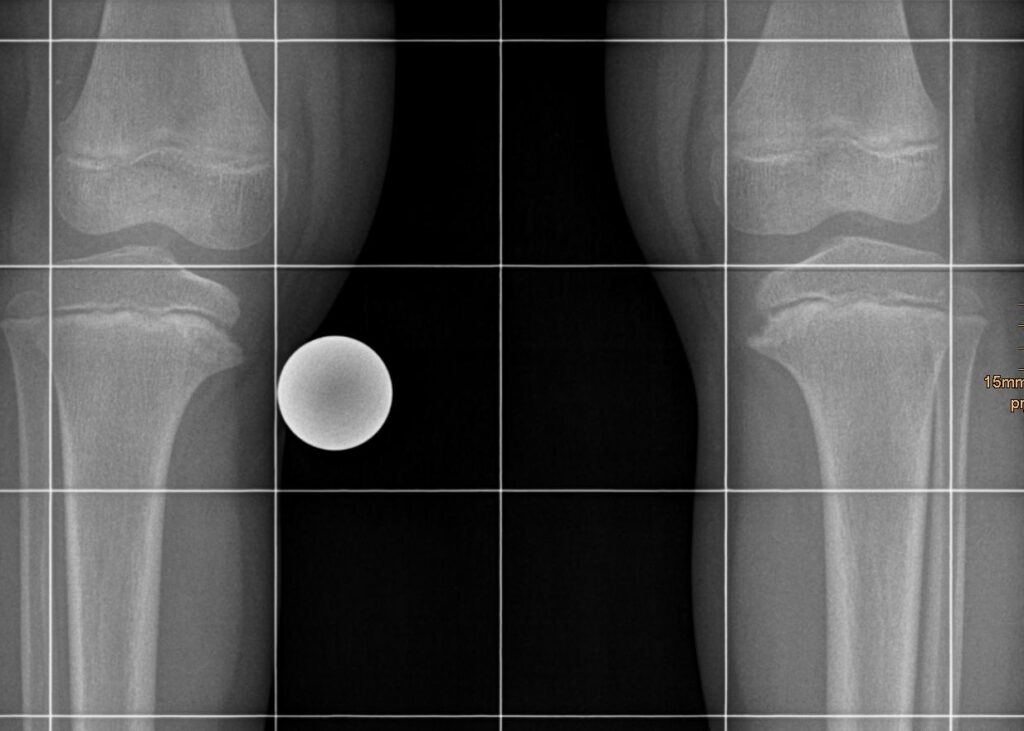
- How do you differentiate physiological bowing from Blount disease?
- How is Blount disease classified?
- Outline management.
Answer
Physiological bowing versus Blount disease
- Physiological genu varum peaks around 1 year and corrects by about 2 years
- Pathological features include progression after age 2, unilateral or asymmetric deformity, a lateral thrust and short stature
- Metaphyseal diaphyseal (Drennan) angle under 10 degrees suggests physiological bowing and over 16 degrees suggests Blount disease
- Exclude rickets, skeletal dysplasia and post-traumatic causes
Classification
- Infantile (under 4 years) and adolescent (over 10 years) forms
- Langenskiöld stages I to VI for infantile Blount disease, from metaphyseal beaking to a medial physeal bony bar
Management
- Knee ankle foot orthosis for Langenskiöld stage I or II under 3 years, with mixed evidence
- Proximal tibial valgus derotation osteotomy before age 4 for progressive deformity, overcorrecting slightly
- Lateral hemiepiphysiodesis (guided growth) for milder deformity with growth remaining
- Bar resection, medial plateau elevation and gradual correction with an external fixator for late stages
- Weight management, particularly in adolescent Blount disease
Related pages
Author Contributions
Orthofracs team
Reviewed by Professor Phong Tran, Head of Orthopaedic Surgery, Western Health. Last updated 10 October 2026.