
Question
A 4 month old boy is referred with short limbs. His face and hand are shown.
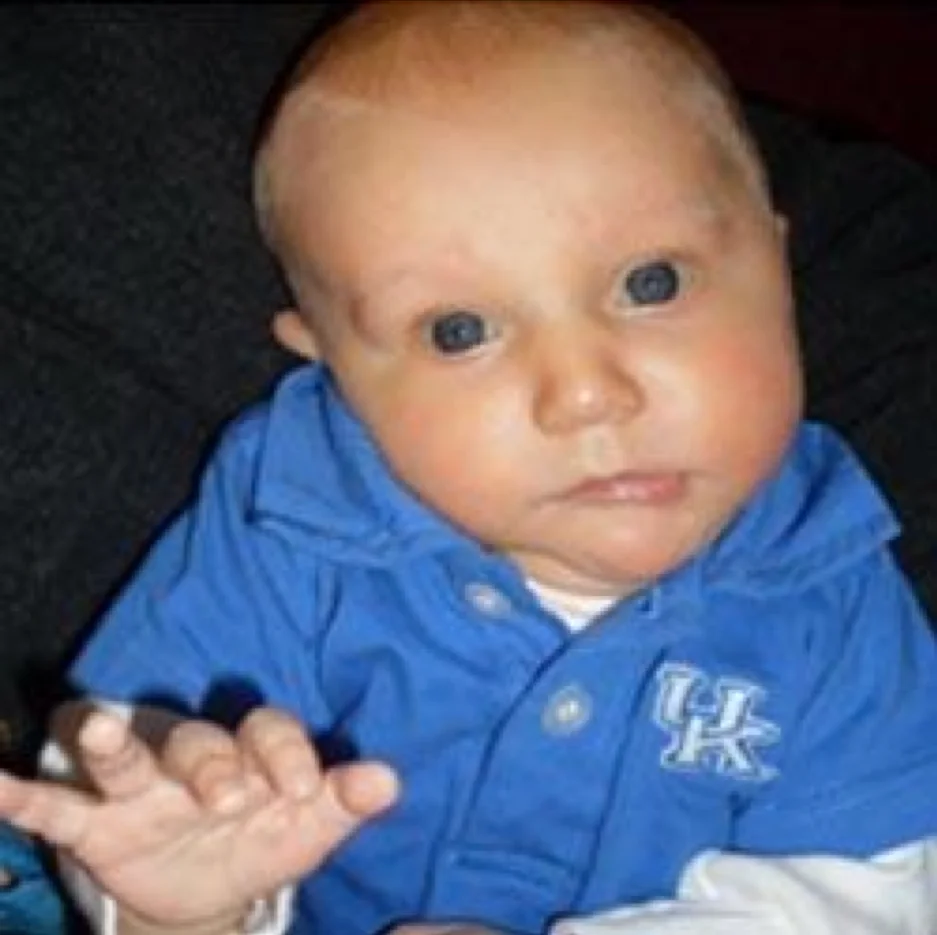
- What is your diagnosis?
- What is the natural history?
- What else will you look for?
- How is it classified, and what are the treatment and surgical options?
Answer
Diagnosis
- Achondroplasia, the most common skeletal dysplasia
- Frontal bossing, midface hypoplasia and a trident hand with separation of the middle and ring fingers
- Autosomal dominant gain of function mutation in FGFR3, about 80% new mutations, linked to advanced paternal age
Natural history
- Rhizomelic short stature with normal trunk length and normal intelligence
- Adult height about 125 to 130 cm
- Infant hypotonia and delayed motor milestones
- Thoracolumbar kyphosis in infancy that usually resolves after walking
- Genu varum and lumbar spinal stenosis in adulthood
What else to look for
- Foramen magnum stenosis causing cervicomedullary compression, central apnoea and sudden death, needing early MRI and sleep studies
- Hydrocephalus
- Otitis media and obstructive sleep apnoea
- Thoracolumbar kyphosis, elbow flexion contracture and radial head subluxation
Classification
- A skeletal dysplasia of the FGFR3 group in the Nosology of Genetic Skeletal Disorders
- Spectrum includes hypochondroplasia (milder) and thanatophoric dysplasia (lethal)
Treatment and surgical options
- Multidisciplinary care with paediatrics, neurosurgery and ENT
- Avoid unsupported sitting and early kyphosis bracing if it persists
- Foramen magnum decompression for symptomatic stenosis
- Guided growth or osteotomy for progressive genu varum
- Extended laminectomy for lumbar stenosis, often across many levels
- Limb lengthening is controversial
- Vosoritide (C type natriuretic peptide analogue) increases growth velocity in children with open physes
Related pages
Author Contributions
Orthofracs team
Reviewed by Professor Phong Tran, Head of Orthopaedic Surgery, Western Health. Last updated 10 October 2026.