
Question
A 30 year old man falls 4 metres from scaffolding and lands on his feet. He has back pain at the thoracolumbar junction and normal neurology. CT shows an L1 burst fracture.
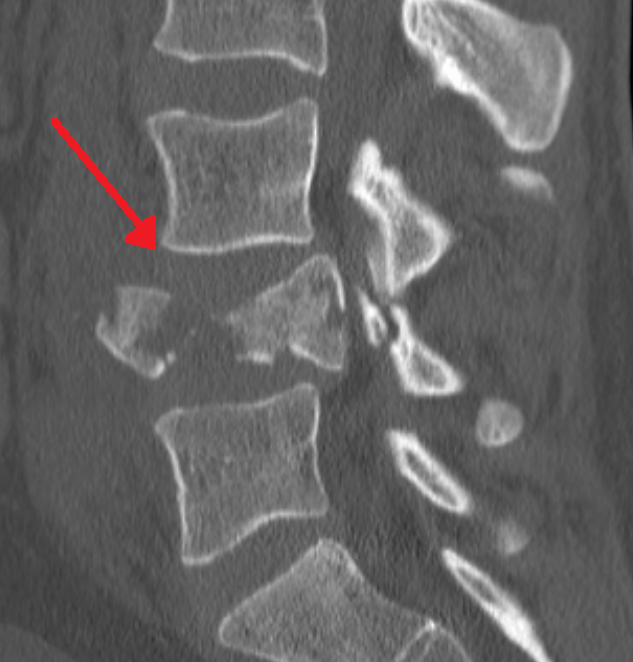
- How would you classify this injury?
- What features suggest instability?
- Outline your management.
Answer
Classification
- AO Spine thoracolumbar classification, type A3 or A4 burst fracture, with neurological status and modifiers
- TLICS scores morphology, posterior ligamentous complex integrity and neurology, with surgery suggested for a score over 4
- Denis three column concept of anterior, middle and posterior columns
Features of instability
- Posterior ligamentous complex disruption on MRI or widened interspinous distance
- Translation or rotation, type B or C injuries
- Kyphosis over about 25 to 30 degrees
- Loss of vertebral body height over 50%
- Neurological deficit
Management
- ATLS assessment and examination of the whole spine, as non-contiguous fractures occur in about 10%
- Look for associated calcaneal fractures from the axial load
- Neurologically intact stable burst fractures can be treated with early mobilisation, with or without a brace, and have similar outcomes to surgery
- Posterior instrumented stabilisation for posterior ligamentous complex injury, deformity or neurological deficit
- Anterior column reconstruction for severe comminution or persistent canal compromise with deficit
Related pages
Author Contributions
Orthofracs team
Reviewed by Professor Phong Tran, Head of Orthopaedic Surgery, Western Health. Last updated 10 October 2026.