
Question
A 19 year old Australian rules footballer has had four anterior shoulder dislocations in the last year, the last with minimal trauma.
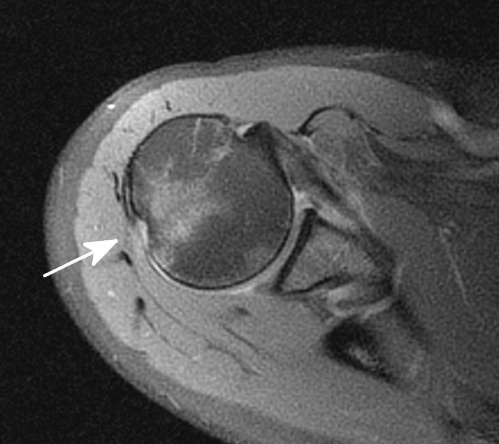
- What are the risk factors for recurrence?
- What imaging would you request and what would you look for?
- What surgical options are available, and how would you choose?
Answer
Risk factors for recurrence
- Age under 20 at first dislocation, male sex and contact or overhead sport
- Glenoid bone loss and an engaging Hill-Sachs lesion
- Hyperlaxity and previous failed stabilisation
- Instability Severity Index Score (ISIS) above 6 predicts failure of arthroscopic Bankart repair
Imaging
- AP, axillary and West Point or Bernageau views for a bony Bankart lesion
- MRI arthrogram for the labrum, capsule and HAGL lesion
- CT with 3D reconstruction to measure glenoid bone loss with the best fit circle method
- Assess the glenoid track to decide whether the Hill-Sachs lesion is on track or off track
Surgical options
- Arthroscopic Bankart repair for soft tissue lesions with glenoid bone loss under about 15%
- Add remplissage for an off track Hill-Sachs lesion with modest glenoid bone loss
- Latarjet coracoid transfer for glenoid bone loss over about 20%, contact athletes with high ISIS or failed soft tissue repair
- Free bone block (iliac crest or distal tibia allograft) for revision or large defects
- Rehabilitation and return to sport at about 4 to 6 months
Related pages
Author Contributions
Orthofracs team
Reviewed by Professor Phong Tran, Head of Orthopaedic Surgery, Western Health. Last updated 10 October 2026.