
Question
A 10 year old boy had a Salter-Harris IV fracture of the distal femur 18 months ago. He now has a leg length difference and increasing genu valgum.
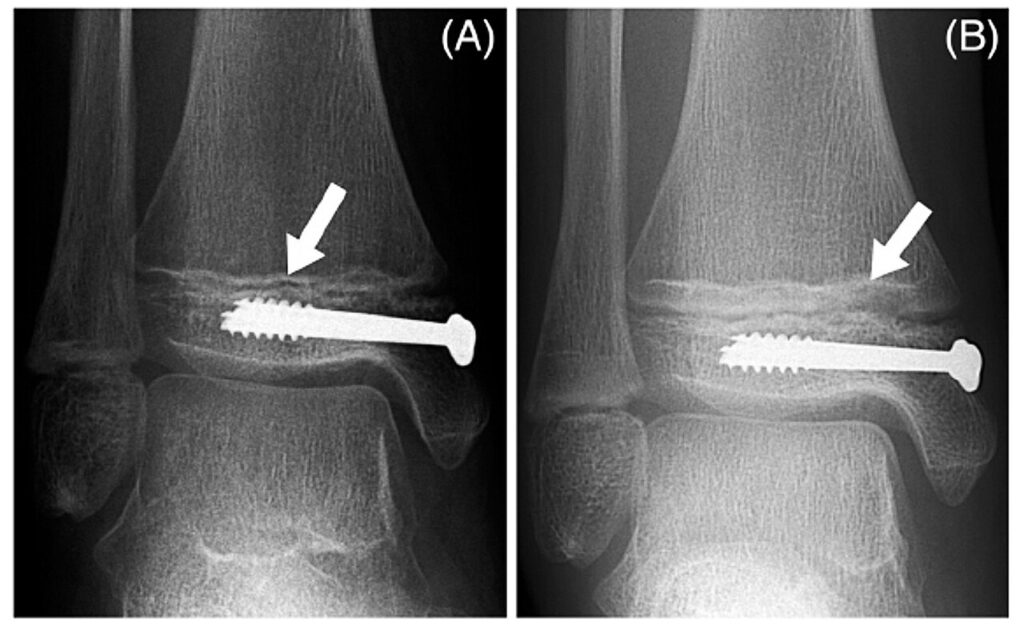
- What has happened and how would you investigate it?
- How do you predict the leg length discrepancy at maturity?
- Outline your management options.
Answer
Diagnosis and investigation
- Partial physeal arrest with a physeal bar, causing angular deformity and shortening
- Distal femoral physeal fractures have a high rate of growth arrest
- Harris growth arrest lines that converge toward the bar
- MRI or CT mapping to measure the size and location of the bar, as a percentage of physeal area
Predicting discrepancy
- Distal femur grows about 9 to 10 mm a year and the proximal tibia about 6 mm a year
- Moseley straight line graph, Green and Anderson tables, or the Paley multiplier method
- Bone age from hand radiographs
Management options
- Physeal bar resection with interposition of fat or cement if the bar is under about 50% of the physis and more than 2 years of growth remain
- Completion of the arrest and contralateral epiphysiodesis for larger bars or limited growth
- Guided growth with tension band plates for angular deformity
- Corrective osteotomy for established deformity
- Limb lengthening for large predicted discrepancy
Related pages
Author Contributions
Orthofracs team
Reviewed by Professor Phong Tran, Head of Orthopaedic Surgery, Western Health. Last updated 10 October 2026.