
Question
A 9 year old girl falls onto her outstretched hand. She has lateral elbow pain and pain on forearm rotation.
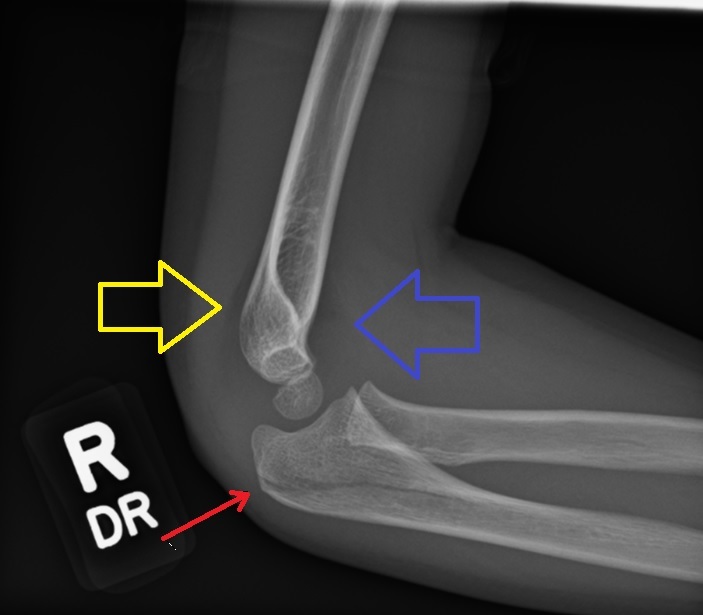
- What signs are marked on the radiograph?
- What injuries might be present?
- How are radial neck fractures classified and treated?
Answer
Signs
- Elevated anterior fat pad (sail sign)
- Visible posterior fat pad, always abnormal
- Haemarthrosis implies an occult fracture
- Radial neck fracture line
Possible injuries
- Undisplaced supracondylar fracture, the most common occult injury
- Radial neck fracture
- Lateral condyle fracture
- Olecranon fracture
- Medial epicondyle fracture
Radial neck fractures
| Judet type | Angulation |
|---|---|
| I | Undisplaced |
| II | Under 30 degrees |
| III | 30 to 60 degrees |
| IVa | 60 to 80 degrees |
| IVb | Over 80 degrees |
- Accept up to 30 degrees angulation and 3 mm translation in children under 10
- Collar and cuff with early motion for acceptable angulation
- Closed reduction (Israeli or Patterson technique)
- Percutaneous K-wire joystick reduction
- Elastic nail (Metaizeau) reduction and fixation
- Avoid open reduction and never excise the radial head in children
- Complications are stiffness, AVN, radioulnar synostosis and premature physeal closure
Related pages
Author Contributions
Orthofracs team
Reviewed by Professor Phong Tran, Head of Orthopaedic Surgery, Western Health. Last updated 10 October 2026.