
Question
A 60 year old man felt a pop above his kneecap after slipping on stairs and cannot straight leg raise. There is a palpable gap above the patella.
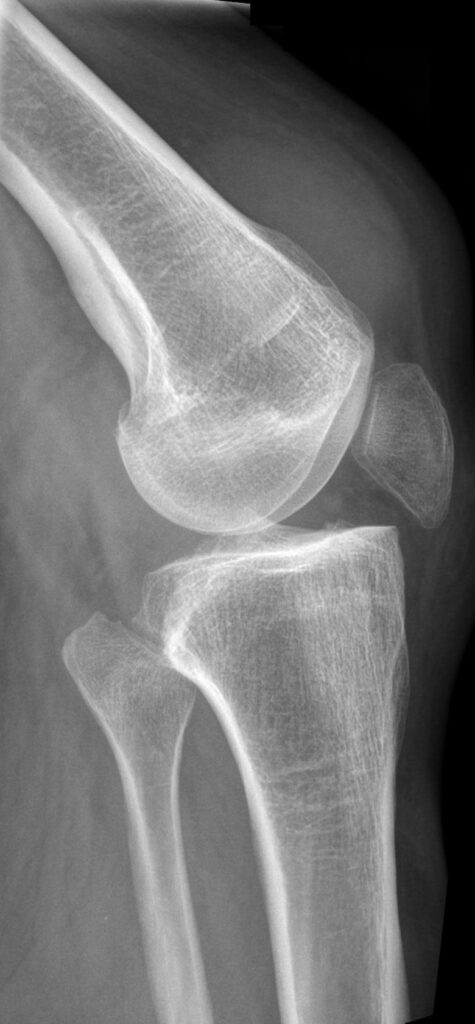
- What is the diagnosis and what are the risk factors?
- How would you confirm it?
- Describe your management.
Answer
Diagnosis and risk factors
- Quadriceps tendon rupture, usually in patients over 40
- Patellar tendon ruptures are more common under 40
- Risk factors include chronic kidney disease, diabetes, gout, rheumatoid arthritis, steroids, fluoroquinolones and obesity
- Bilateral ruptures suggest systemic disease
Confirmation
- Inability to perform a straight leg raise or hold the extended knee against gravity
- Palpable suprapatellar gap and patella baja on lateral radiograph
- Ultrasound or MRI for partial tears or uncertain cases
Management
- Partial tears with an intact straight leg raise are treated in a brace locked in extension
- Complete ruptures need early repair, ideally within 2 weeks
- Locking sutures through transosseous patellar tunnels or suture anchors
- Chronic retracted tears need V-Y quadricepsplasty or augmentation with graft
- Hinged brace locked in extension, then progressive flexion over 6 weeks
- Avoid resisted extension for about 12 weeks
Related pages
Author Contributions
Orthofracs team
Reviewed by Professor Phong Tran, Head of Orthopaedic Surgery, Western Health. Last updated 10 October 2026.