
Question
A 35 year old man has medial knee pain and locking after a twisting injury. MRI shows a vertical longitudinal tear of the peripheral medial meniscus.
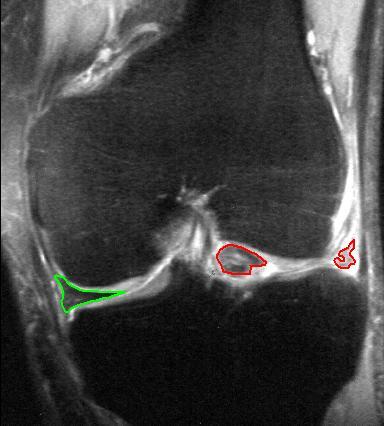
- How are meniscal tears classified?
- Which tears can be repaired?
- Describe your repair techniques and rehabilitation.
Answer
Classification
- By zone of vascularity, red red (outer third), red white and white white (inner third)
- By pattern, vertical longitudinal, radial, horizontal cleavage, flap, complex and bucket handle
- Root tears, which cause loss of hoop stress function similar to total meniscectomy
- Degenerative tears in older patients
Repairable tears
- Vertical longitudinal tears in the red red or red white zone
- Acute tears in young patients
- Repair at the time of ACL reconstruction heals better
- Root tears in knees without significant arthritis
- Degenerative tears in middle aged patients without mechanical locking are treated with physiotherapy, as arthroscopic partial meniscectomy has little benefit
Repair techniques
- Inside out repair with vertical mattress sutures, the gold standard, protecting the saphenous nerve medially and the peroneal nerve laterally
- All inside devices for posterior horn tears
- Outside in repair for anterior horn tears
- Transtibial pull out repair for root tears
- Rasp the tear edges and consider marrow venting to improve healing
Rehabilitation
- Protected weight bearing and limited flexion for 4 to 6 weeks
- Avoid deep squatting for about 4 months
- Failure rates of about 15 to 25%
Related pages
Author Contributions
Orthofracs team
Reviewed by Professor Phong Tran, Head of Orthopaedic Surgery, Western Health. Last updated 10 October 2026.